
Eddie Codel
The Three Tiers of Kirkjufellsfoss
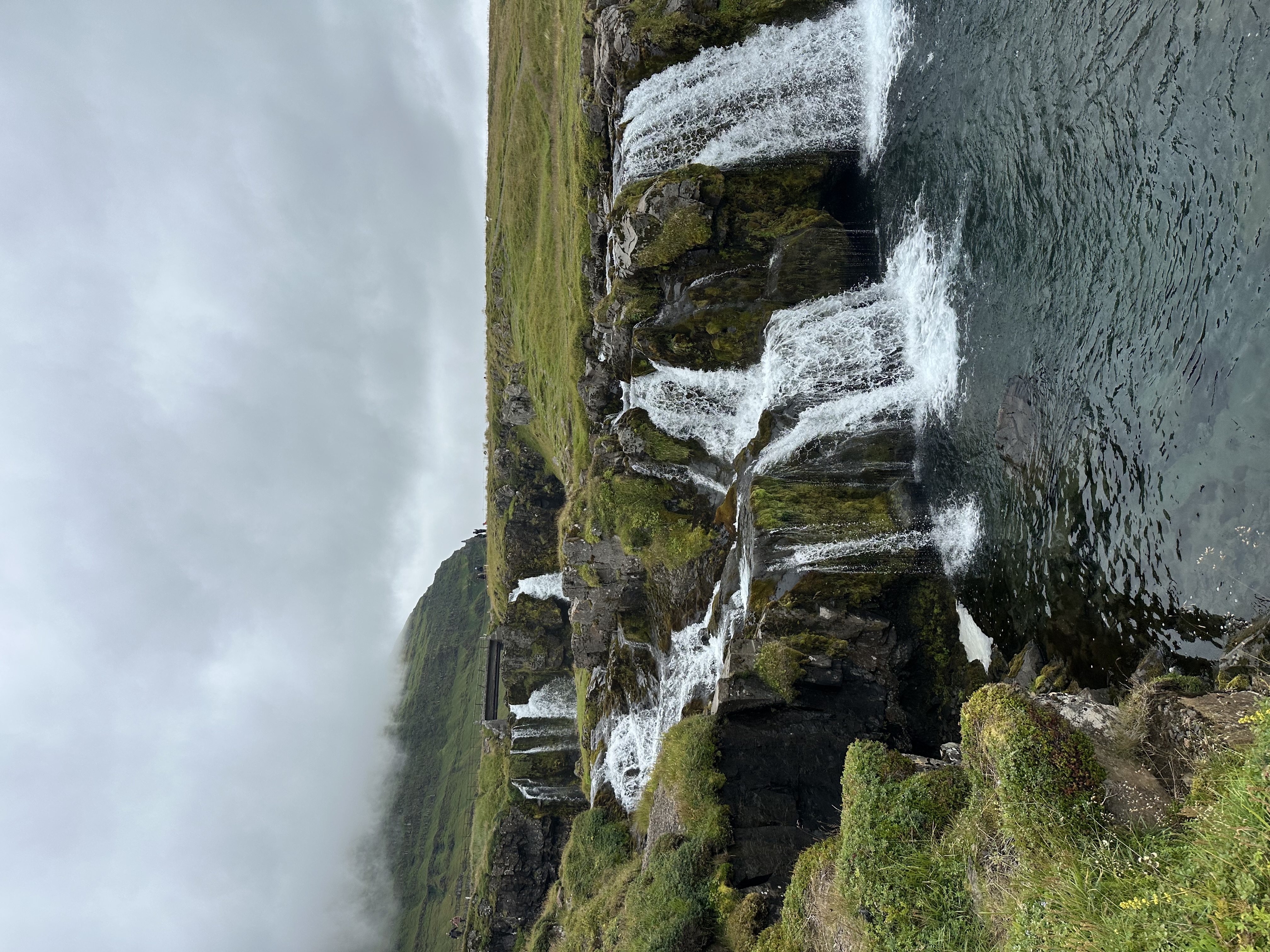
Known as the "Church Mountain Falls," Kirkjufellsfoss is one of the most photographed locations in Iceland, largely because it provides the perfect foreground for the iconic, cone-shaped mountain Kirkjufell. While the falls themselves are relatively modest in height compared to some of Iceland’s massive glacial cascades, their unique structure—a series of three distinct channels dropping into a calm pool—makes them a masterclass in hydraulic geology.
These falls are fed by the meltwater of the Snaefellsjökull glacier and nearby mountain runoff. The rock layers you see forming the steps of the waterfall are primarily composed of basalt and tuff, which were laid down during alternating periods of volcanic activity and glacial advances over millions of years. This layering is a visual timeline of the Snæfellsnes Peninsula’s violent volcanic history.
To a visitor from North America or Europe, the landscape might feel strangely familiar yet otherworldly. This is because this specific area served as a prominent filming location for "Game of Thrones," where the nearby mountain was depicted as the "Arrowhead Mountain" north of the Wall.
The lush green moss clinging to the dark volcanic rock is a species called *Racomitrium lanuginosum*, or Woolly Fringe-moss. It is incredibly delicate and can take decades to recover if stepped on, which is why you’ll notice many roped-off areas and designated paths. This moss plays a crucial role in the Icelandic ecosystem by stabilizing the loose volcanic soil and retaining moisture in a land where the weather can change from bright sunshine to a misty gale in a matter of minutes.
The Geological Architecture of Kirkjufellsfoss
Kirkjufellsfoss is a series of three waterfalls fed by the glacial meltwaters of the Snaefellsjökull volcano. The distinct columnar basalt formations visible behind the falling water are the result of rapid cooling of lava flows, which contracted into hexagonal pillars millions of years ago.
This specific site gained global recognition as "Arrowhead Mountain" in *Game of Thrones*, serving as the backdrop for the creation of the Night King. While the waterfalls appear natural, the surrounding landscape was heavily shaped by Quaternary glaciers, which carved the U-shaped valley and left the iconic Kirkjufell mountain (obscured by mist) as a "nunatak"—a peak that protruded above the ice sheet. The river, Kirkjufellsá, remains remarkably clear because it is filtered through volcanic rock, though its volume fluctuates significantly based on seasonal snowmelt.
The Falls of the Arrowhead Mountain
Kirkjufellsfoss. Fed by meltwater from the extinct Snaefellsjökull volcano. Three-pronged fall dropping into the Grundarfjörður river. Iconic due to its proximity to Kirkjufell (Church Mountain), a 463m volcanic neck composed of basalt and tuff strata. Formed by glacial erosion carving away a nunatak—a peak piercing through an ice sheet.
Geology: Columnar basalt formations visible in the rock face, formed by rapid cooling of thick lava flows. The area is part of the Snæfellsnes volcanic system, active for 7 million years.
Pop culture: Famed as "Arrowhead Mountain" in *Game of Thrones*, representing the birthplace of the Night King. The surrounding moorland features heavy moss cover (*Racomitrium lanuginosum*), a pioneer species essential for soil production on lava fields but extremely fragile; stepping on it can cause damage that takes decades to recover.