UG
Ulrich Gall
The Sacred Heart of the Coffee Farmer
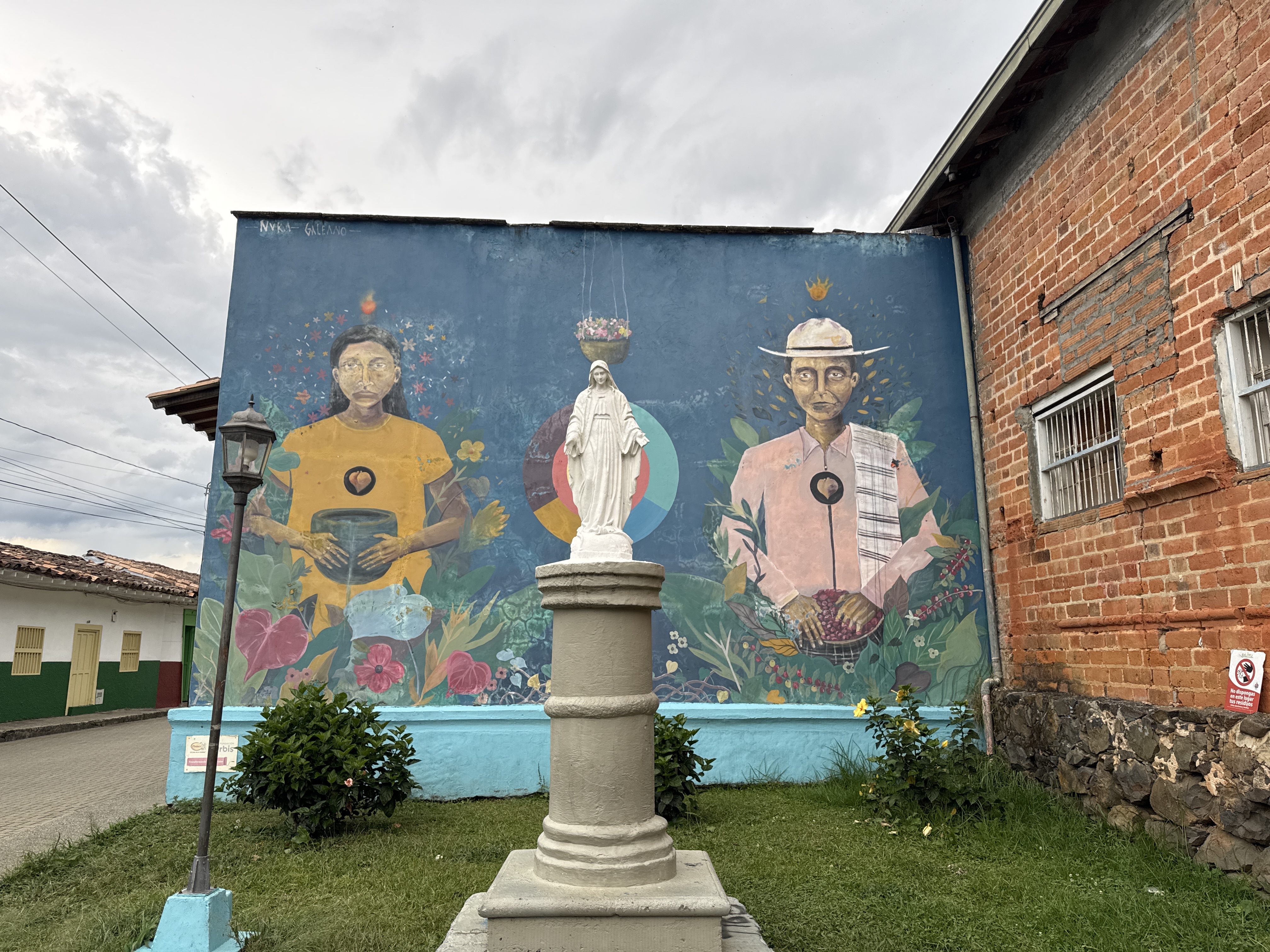
Jericó is often called the "Athens of Southwest Antioquia," and this striking mural by local artist Nyko Galeano captures the town's unique identity—a place where deep-seated Catholicism meets a fierce pride in its peasant roots. The woman on the left represents the traditional "partera" or midwife, associated with life and the nurturing of the earth, while the man on the right is a "cafetero," or coffee farmer. He is seen harvesting red coffee cherries and wearing the "carriel," the iconic leather satchel synonymous with the region.
The central figure is a statue of the Virgin Mary, positioned in front of a colorful halo that mirrors the vibrant architecture found throughout the town. Jericó is particularly famous as the birthplace of Mother Laura Montoya, Colombia's first saint, which has turned the town into a major site of pilgrimage. This explains why religious iconography, like the statue and the sacred hearts on the figures' chests, is woven so seamlessly into murals that celebrate common laborers.
The mural's style is inspired by Latin American "Costumbrismo," focusing on the daily lives and customs of ordinary people, but it adds a touch of magical realism. Notice how flowers bloom from the midwife's hair and coffee leaves sprout from the farmer's shoulders, suggesting that in the Antioquian countryside, the people are not just working the land—they are an extension of it. The signature at the top left, “NYKO GALEANO,” belongs to a prominent muralist who uses his work to reclaim public spaces and tell the story of the Colombian "pueblo."
Even small details here carry weight: the red sign on the brick wall to the right warns against littering, a common sight in these meticulously kept colonial towns. In Jericó, pride in one's home and heritage is visible in every painted facade and every petal of the flowers that hang from the balconies.
Faith and Fincas in Jericó
In the traditional coffee-growing town of Jericó, this site exemplifies the cultural intersection of Catholic devotion and agricultural identity. The mural (signed by artist Nyka Galeano) depicts a coffee farmer wearing a *carriel*—the quintessential leather satchel of the Antioquian *arriero* (muleteer). The *carriel* is so central to local identity that Jericó is recognized as the world capital of its production.
The central statue is the Virgin of the Miraculous Medal, but the town’s spiritual identity is primarily defined by Saint Mother Laura Montoya, Colombia’s first saint, who was born in Jericó in 1874. Her influence makes this town a major pilgrimage site.
The juxtaposition of the Virgin and the peasant figures highlights the "Coffee Cultural Landscape," a UNESCO World Heritage region where rural life is inseparable from religious faith. The man holding coffee cherries and the woman with a water vessel represent the fundamental elements of the local economy: the labor-intensive hand-harvesting of Arabica beans and the vital water resources provided by the surrounding Western Andes.
Faith and Coffee in Jericó
Known as the "Athens of the Southwest," Jericó is a deeply religious town famous as the birthplace of Mother Laura Montoya, Colombia's first saint. This mural by local artist Nyka Galeano blends traditional Catholic devotion with "Paisa" coffee culture.
The central statue is the Virgin of the Miraculous Medal. To her right, a campesino wears the iconic *sombrero aguadeño* and a *carriel*—a multi-compartment leather satchel unique to this region, historically used by muleteers to carry everything from money to tobacco and luck charms. The red berries in his hands reflect Antioquia’s primary economy: high-altitude Arabica coffee.
The "bloody hearts" centered on both figures reference the Sacred Heart of Jesus, a powerful socio-political symbol in Colombia. In 1902, the country was officially consecrated to the Sacred Heart to end the "Thousand Days' War." This fusion of agrarian labor and mysticism is quintessential to the conservative, mountain-dwelling identity of Suroeste Antioqueño. Note the halo-like discs behind the Virgin; these represent the "M" and Cross from the Miraculous Medal, signaling divine protection over the local harvesters.