UG
Ulrich Gall
The Poetical Walls of Jericó
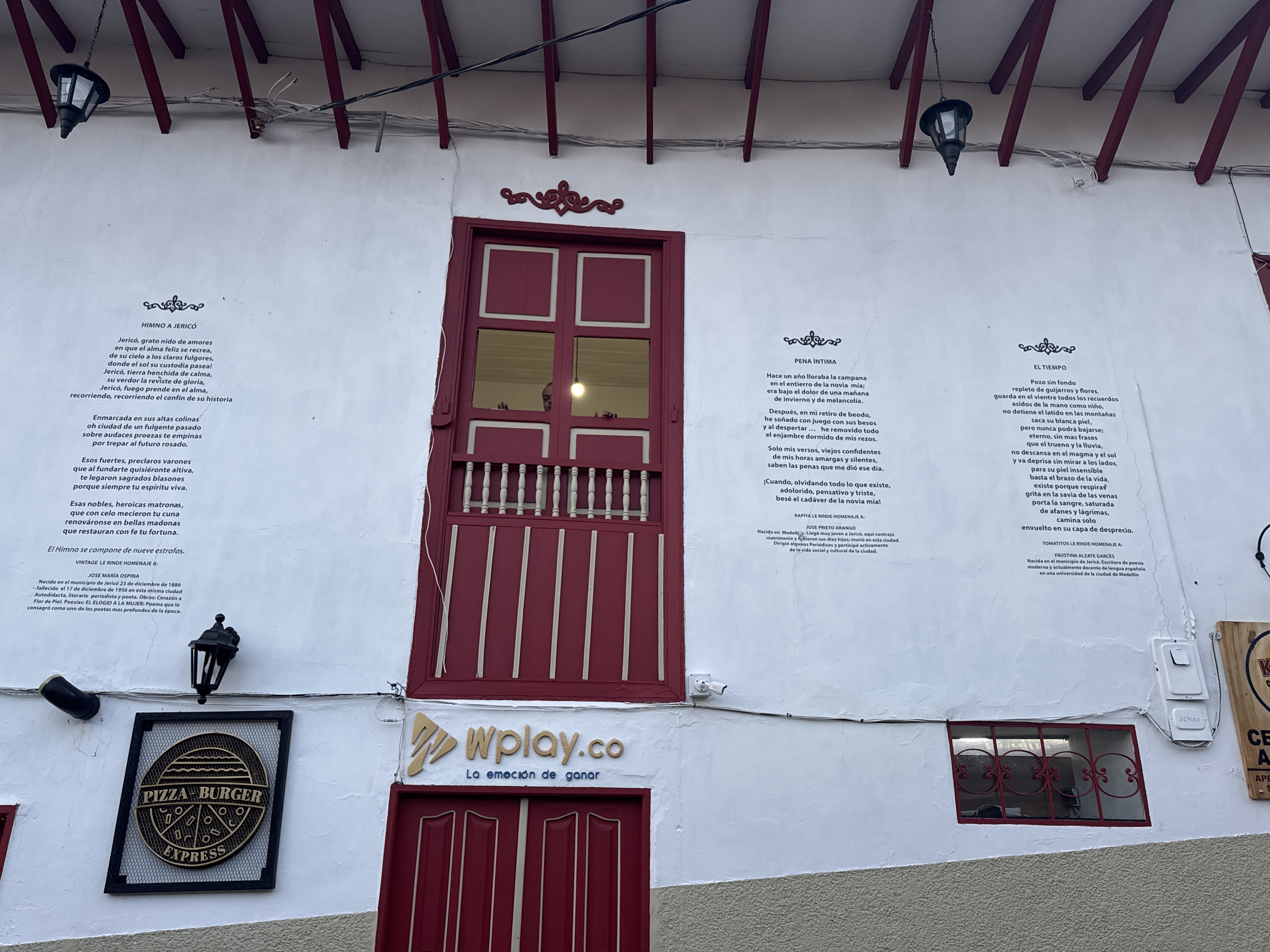
Here, in the labyrinthine streets of Jericó, we encounter a facade that speaks to the profound and often crushing weight of human existence. It is a wall of white lime, punctuated by the blood-red frames of a tradition that refuses to wither. Look closely at this architecture; it is not merely a building, it is a testament to the inescapable urge to manifest the internal landscape upon the external world.
On this wall, the town has seen fit to transcribe poetry and hymns directly onto the masonry. To the left, we find the *Himno a Jericó*. It is an anthem of pride, a desperate shout into the void of the Andean mountains, claiming a glory that the indifferent sun witnesses daily without comment. Then there is "Pena Íntima"—Intimate Sorrow. It is a poem that speaks of the burial of a young girl, of a heart frozen in a winter of melancholy. Why must we paint our tragedies on the very walls where we also sell pizza and burgers? It is because the human spirit is a strange, swirling vortex of the commercial and the catastrophic.
The window above—framed in that same aggressive crimson—offers a glimpse into an interior life that remains obscured, while below, the bold gold of a betting shop, *Wplay.co*, promises a fortune that is, in all likelihood, an illusion. It is a magnificent, terrible irony. We walk past the verses of dead poets, contemplating the "sap of the veins" and "layers of contempt" mentioned in the poem *El Trapo* to the right, only to be confronted by the immediate, primal desire to win at games of chance.
In Jericó, every wall is a manuscript. The town, known as the "Athens of the Southwest," does not merely inhabit its history; it forces the passerby to collide with it. It is a beautiful, overwhelming struggle against the silence of nature.
The Poet's Wall of Jericó
The colorful red woodwork and crisp white walls you see are the aesthetic signature of Jericó, often cited as one of the most beautiful "Pueblos Patrimonios" (Heritage Towns) in Colombia. However, what makes this specific wall remarkable is that it serves as an open-air library, celebrating the town’s deep-seated identity as the "Athens of Southwest Antioch."
While many towns in this region focuses solely on coffee production, Jericó has long prided itself on its intellectual and literary contributions. The text on the wall is not decoration; it consists of poems and the town’s official anthem, honoring figures like Jose Maria Ospina and Ciro Pinzon Arango. These writers were instrumental in shaping the cultural fabric of a town that produced Colombia's first female saint, Mother Laura Montoya.
The poem on the far left, the "Himno a Jericó," describes the town as a "grateful nest of loves" and praises its "nobles, heroic matrons." This reflects the local pride in the community’s resilience and its history of strong, faith-driven families. To the right, "Pena Íntima" (Intimate Sorrow) by Ciro Pinzon Arango offers a more melancholic, evocative glance into the soul of the region's poets.
The architectural style here is known as "Colonización Antioqueña." You can see this in the wooden balcony—sometimes called a *mochetón* when integrated into the wall like this—and the vibrant oxblood red paint, which was traditionally made by mixing pig’s blood with lime, though modern paints are used today. Even mundane commercial spaces, like the pizza parlor and the betting shop indicated by the "Wplay" logo, are required to maintain this historic facade to preserve the village's cultural heritage status. This blend of high-brow poetry and everyday commerce on a single wall captures the unique spirit of a town where culture isn't just in a book, but literally written on the streets for every passerby to read.
The Poetic Facade of Jericó
This building in Jericó showcases the town's identity through literature, specifically highlighting its "Antioquian Village" heritage. The text to the left is the **Himno a Jericó**, the official municipal anthem written by José María Ospina. It celebrates the town’s founding "valiant men" and "heroic matrons," reinforcing a local pride in the region’s conservative, Catholic roots.
The center poem, **"Pena Íntima"**, is by Ciro Prieto Arango, a poet who embodies the traditional *costumbrismo* style of the region—art that focuses on local customs and everyday life. The text on the right, **"El Trapo"** by Faustina Alzate Garcés, reflects the town's reputation as the "Athens of the Southwest" for its high density of writers and intellectuals per capita. Jericó is also the birthplace of Santa Laura Montoya, Colombia's first saint, which contributes to the deeply pious and scholarly atmosphere reflected in these public displays of verse.
The Poet’s Walls of Jericó
Traditional Bahareque architecture meets cultural preservation in Jericó, Antioquia. This facade features poems written directly on the lime-washed walls, a local homage to the town’s reputation as the "Athens of Southwest Antioquia."
The texts include the *"Himno a Jericó"* (Town Anthem) by José María Ospina and *"Pena Íntima"* (Intimate Sorrow) by Efe Pardo Arango. Pardo Arango (1894–1959) was a bohemian poet and journalist; his work often touches on melancholic themes of lost love and death—common in the "Paisa" romantic literary tradition.
The structure showcases classic colonial influences: deep red wooden window frames with "tornearía" (lathed balusters) and a "sobreventana" (upper glass pane) for ventilation. Jericó is the birthplace of Santa Laura Montoya, Colombia’s first saint, and maintains a strict aesthetic code to preserve its 19th-century charm. The juxtaposition of these 100-year-old verses with the modern "wplay.co" (sports betting) and pizza signs reflects the town's struggle to balance rapid tourism growth with its intellectual heritage.