UG
Ulrich Gall
Poetry and Pedals in Jericó
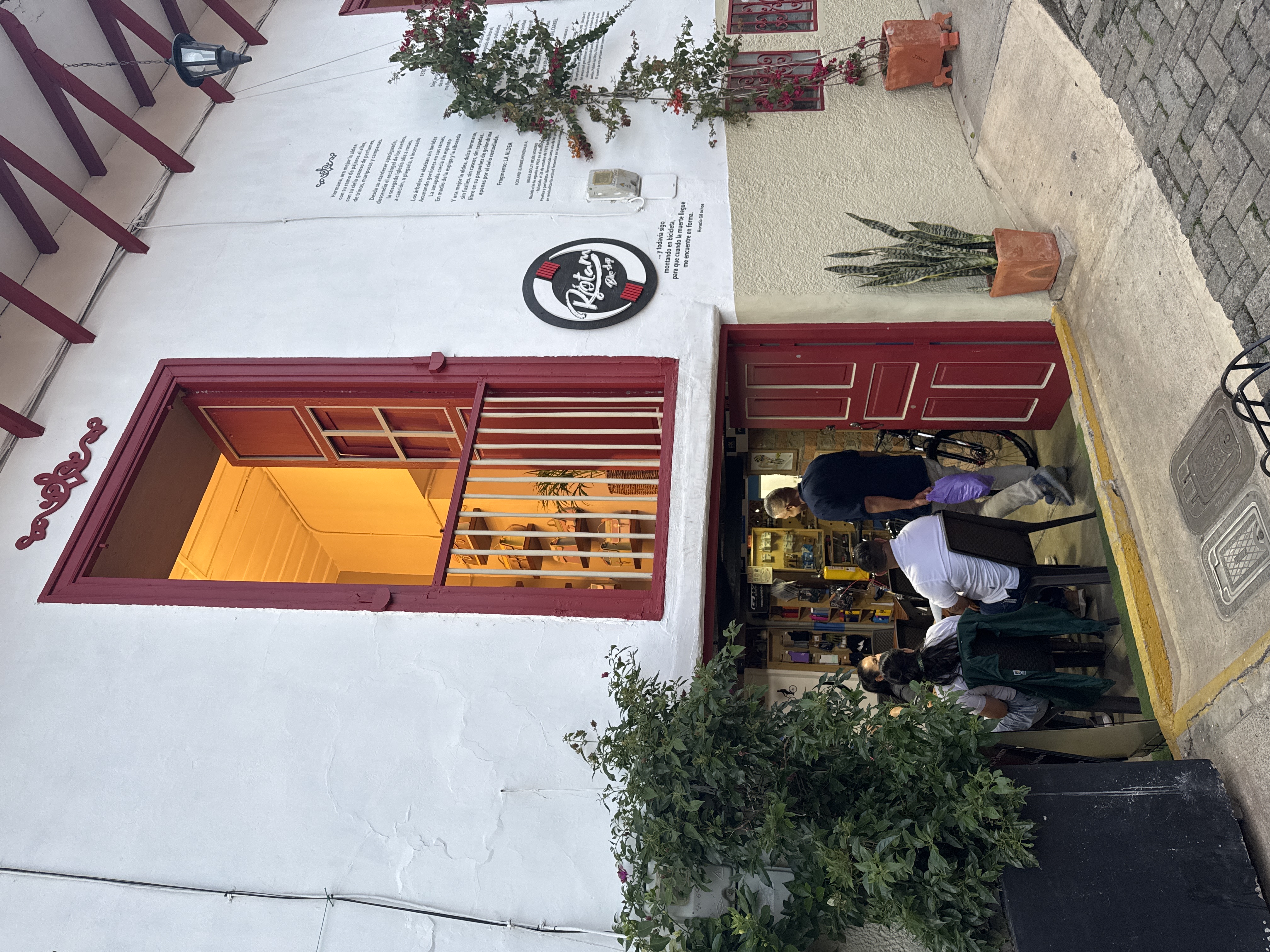
The facade of this building in Jericó highlights a charming architectural quirk common in the mountainous coffee regions of Antioquia: the split-level "zaguán." Because the town is built on steep Andean slopes, many traditional colonial houses feature a main living area on what appears to be the second floor from the street, while the lower level—originally used for stables or storage—has been repurposed into cozy, tucked-away commercial spaces like the bike shop and café seen here.
The sign "Rótam" identifies a local hub for cycling enthusiasts. The name is a play on the Spanish word "rotam," evoking the rotation of wheels. Below the sign is a poetic fragment from the Chilean Nobel laureate Gabriela Mistral, titled "La Aldea" (The Village). The text on the wall describes the simple, evocative beauty of rural life, mentioning the smell of hay, the sound of church bells, and the growth of trees. Mistral actually lived in Jericó for a period in the early 20th century, and the town takes great pride in its literary connections, often painting poetry directly onto the white-washed walls of its heritage buildings.
Even more striking is the quote just below the Rótam logo: "...y todavía sigo; moriré de en bicicleta; para que cuando la muerte llegue me encuentre en forma," which translates to "...and I’m still going; I’ll die on a bicycle; so that when death arrives, it finds me in shape." This reflects the deep-rooted cycling culture of Colombia, where climbing these grueling mountain passes is considered a national pastime.
Inside the shop, you can see the famous "Carrilera" or "Carriel" bags on display. Jericó is the undisputed capital of the Carriel, a traditional leather satchel used by the "arrieros" (muleteers) who founded these towns. These bags are distinctive for their many hidden compartments—historically used to hide money, dice, tobacco, and even love letters—and are a symbol of the hardworking paisa identity.
Carriels and Martyrs of Jericó
Jericó is the birthplace of the **carriel**, the iconic leather crossbody bag of the Colombian *paisa* culture visible in the workshop window. Traditionally worn by muleteers (*arrieros*), these bags are famous for having up to 18 hidden pockets—historically used to conceal money, tobacco, dice, and even cards for gambling or love letters.
The text on the wall is a fragment of "La Aldea," a poem by **Héctor Abad Gómez**, a prominent Colombian human rights activist and physician who was assassinated by paramilitaries in 1987. His life and death are central to modern Colombian history, most famously chronicled in the memoir *Oblivion: A Memoir* (*El olvido que seremos*), written by his son, Héctor Abad Faciolince. The inclusion of this poetry on a commercial storefront reflects Jericó's identity as the "Athens of Southwest Antioquia," a town that prides itself on merging rugged coffee-farming heritage with deep intellectual and religious traditions.
The shop itself, Rótam, blends this tradition with modern cycling culture, a sport that is a national obsession in Colombia due to the country’s steep Andean topography, which produces world-class "climbers" in professional racing.
Cycling, Literature, and Leather in Jericó
Typical of the colonial architecture in the "Pueblo Patrimonio" of Jericó, this building features high ceilings and thick masonry walls designed for thermal regulation in the tropical climate. The ground level, originally used for storage or livestock, now houses **Rótam**, a specialty bike shop and cafe—a reflection of the intense cycling culture in Antioquia. This region is the heartland of Colombian cycling, producing world-class climbers like Rigoberto Urán.
The wall mural features a fragment from *La Aldea*, a seminal work by Jericoano writer **Héctor Abad Gómez**. He was a prominent medical doctor and human rights activist assassinated in 1987 by paramilitaries in Medellín; his life is the subject of the famous book and film *Oblivion: A Memoir* (*El olvido que seremos*). The text reflects on memory and the local landscape. Note the **carriel** shop visible through the upper window; Jericó is the world capital of the *carriel antioqueño*, a traditional multi-compartmented leather satchel essential to the identity of the *arrieros* (muleteers) who founded these mountain towns.