UG
Ulrich Gall
The Poet's Path of Jericó
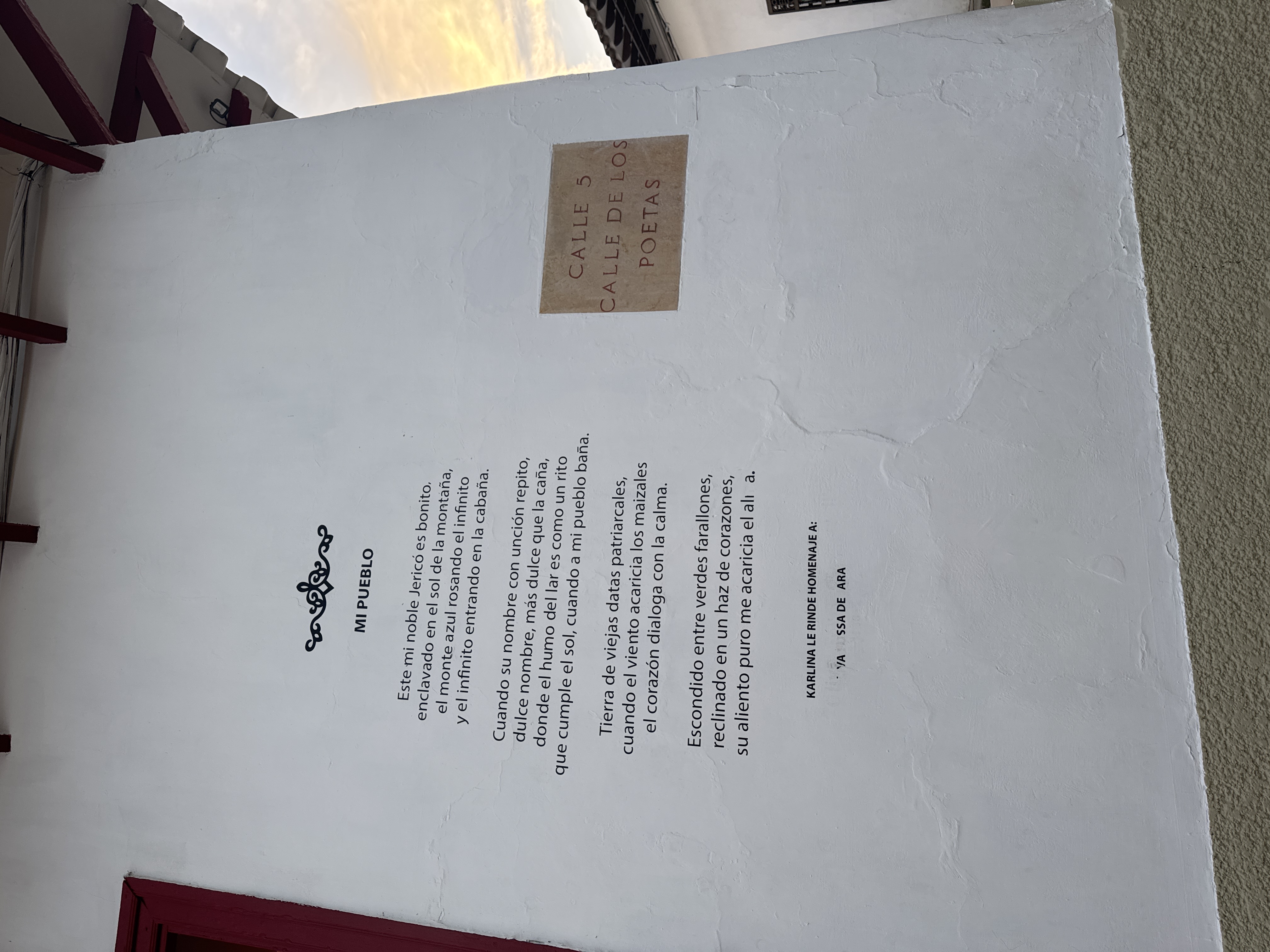
Beyond its reputation as one of Colombia’s most beautiful heritage towns, Jericó is known as the "Athens of Southwest Antioquia" due to its rich history of art, literature, and music. This cultural identity is literally written onto the city’s walls, specifically along Calle 5, which is officially designated as the "Calle de los Poetas" or Street of the Poets. As you walk this street, you encounter various verses painted or engraved on the white-washed facades, turning a simple stroll into an immersive literary gallery.
The poem on this wall, titled "Mi Pueblo" (My Town), is a heartfelt tribute to the local landscape and spirit of Jericó. Its stanzas describe the town as "noble and beautiful," "nestled in the mountain sun," where the blue hills touch the infinite. The poet speaks of the sweetness of the town's name—sweeter than sugarcane—and describes the smoke from the hearths as a sunlit ritual. The mention of "farallones" refers to the dramatic, jagged rocky cliffs that loom over the town, which are a defining geographical feature of this region of the Andes.
This public display of poetry is part of a broader effort in Jericó to preserve its identity as a center of intellect and faith. It’s a town where tradition is held in high regard; it is famously the birthplace of Mother Laura Montoya, Colombia's first saint, and is renowned for its leather craftsmanship, specifically the "Carriel," a traditional leather satchel. The "Calle de los Poetas" serves as a reminder that for the people of Jericó, the beauty of their mountainous home is something to be celebrated through the spoken and written word as much as it is through their famous craft and architecture.
Calle de los Poetas in Jericó
Jericó, Antioquia, is widely known as the "Athens of the Southwest" due to its deep literary roots and preservation of traditional Andean culture. This specific street, Calle 5, is officially designated as the **Calle de los Poetas** (Street of the Poets).
The mural honors this legacy by displaying "Mi Pueblo," a poem by **Dolly Mejía**, one of Colombia’s most significant female poets of the 20th century and a Jericó native. Her work often defied the conservative, patriarchal norms of her time, exploring themes of eroticism and female identity that were considered scandalous in rural Colombia. The verse describes Jericó as a "noble" town "nestled in the mountain sun," referencing the dramatic *farallones* (vertical rock walls) that define the local landscape.
Jericó is also the birthplace of **Santa Laura Montoya**, Colombia’s first saint, and remains a center for the production of the *carriel*, a traditional leather satchel with hidden compartments, often used historically to carry everything from coins to love letters and dice.
Calle de los Poetas in Jericó
Calle 5 in Jericó, known locally as "Calle de los Poetas" (Poets' Street), is a cultural outdoor gallery celebrating the town’s literary legacy. Jericó is famed in Colombia as "The Athens of Southwest" due to its high concentration of writers, intellectuals, and religious history.
The poem on the wall, *Mi Pueblo*, is an ode to Jericó’s rugged landscape—the "blue mount" and "green farallones" (steep rocky cliffs) of the Western Cordillera. It describes the town’s character as "patriarchal," reflecting the deep-rooted conservative Catholic and Paisa traditions of the region.
Jericó is also the site of a fierce ongoing conflict between traditional agricultural/environmental values and large-scale multinational mining interests (notably AngloGold Ashanti's "Quebradona" project). Public displays of poetry like this are often subtle assertions of territorial pride and resistance against industrial shifts that would alter the pastoral "calm" described in the text.