UG
Ulrich Gall
A Public Claim of Ownership
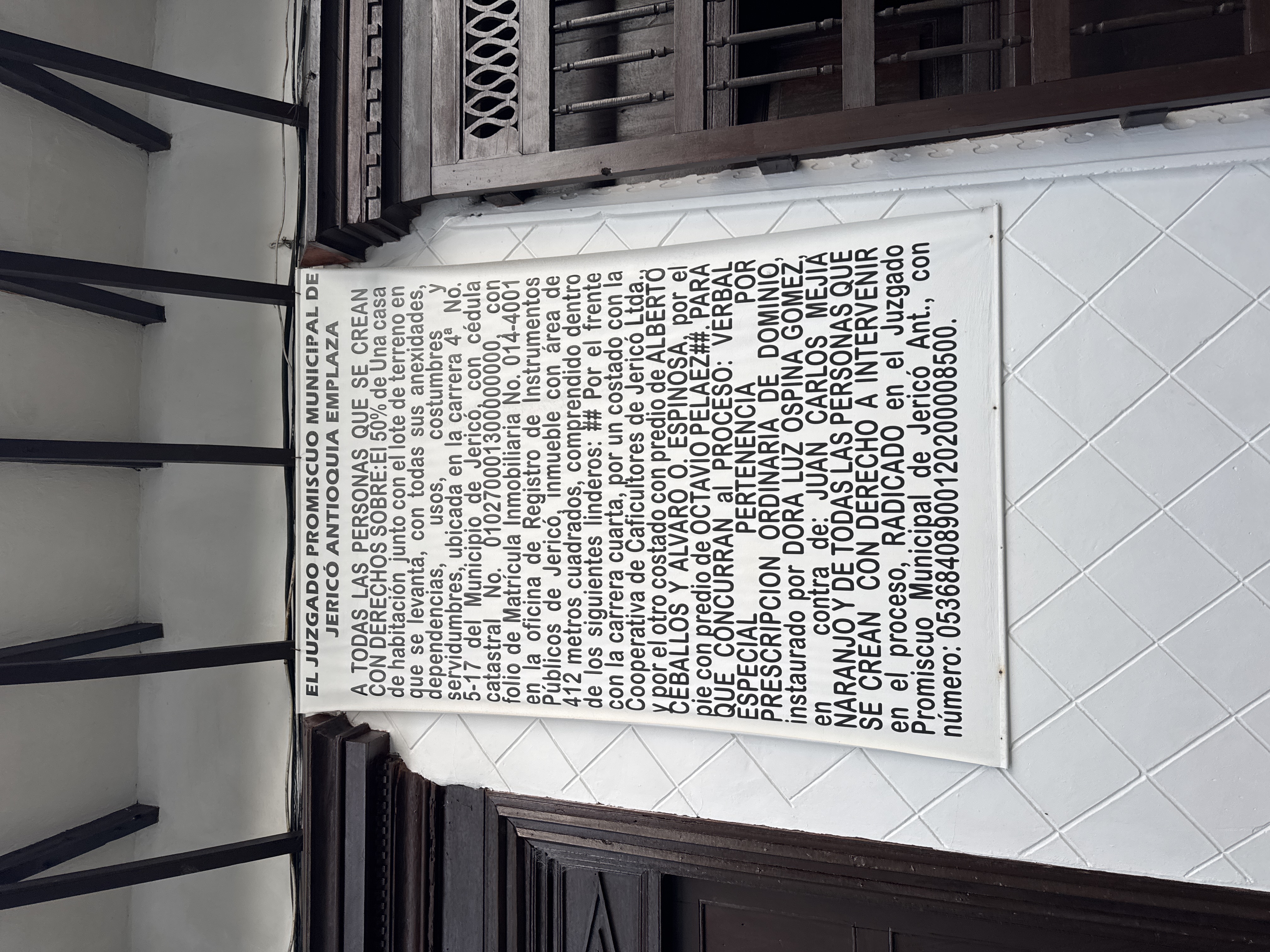
In Colombian law, some of the most important public notices aren't tucked away in a courthouse or a newspaper, but are instead displayed directly on the facades of colonial homes for all to see. The banner here is a formal summons issued by the "Juzgado Promiscuo Municipal"—a local court with broad jurisdiction—notifying the public of a legal battle over the ownership of the very building it is attached to.
The text describes a legal process known as "pertenencia por prescripción ordinaria de dominio," which is a claim of adverse possession. In essence, someone named Dora Luz Ospina Gomez is asking a judge to officially recognize her as the owner of 50% of this house because she has lived in or maintained it for a significant amount of time, challenging the recorded interest of Juan Carlos Mejía Naranjo. The notice lists the exact boundaries of the property, mentioning neighbors like the "Coffee Growers Cooperative of Jericó" to ensure there is no confusion about which plot of land is at stake.
The term "Juzgado Promiscuo" might sound odd to an English speaker, but in the Colombian legal system, it refers to a "mixed" or "general" court found in smaller towns. Because Jericó is a relatively small municipality, its judges handle everything from civil disputes and property claims to criminal cases, rather than having specialized courts for each.
Posting these large, high-contrast banners is a standard legal requirement in Colombia. It serves as a transparent way to ensure that anyone who might have a claim to the property or a "right to intervene" is made aware of the proceedings before a final ruling is made. In a town like Jericó, where history and lineage are deeply intertwined with the physical architecture of the colorful streets, these signs are a modern manifestation of a long tradition of public accountability.
Adverse Possession Legal Summons
This sign is an official "Emplazamiento," a public legal summons issued by the Municipal Court of Jericó. In Colombia, these notices are physically posted on properties when a legal action—specifically a "Proceso de Pertenencia"—is initiated to claim ownership of a building through adverse possession.
A "Proceso de Pertenencia" allows an individual (in this case, Dora Luz Ospina Gómez) to gain legal title to a property if they have lived in it or maintained it as if they were the owner for a specific period (usually 10 years). This specific claim is for 50% of the house located at Carrera 4 No. 5-17. The court posts this publicly to alert the official registered owner (Juan Carlos Mejía Naranjo) or any heirs and creditors, giving them a chance to contest the claim in court before the deed is legally transferred to the claimant.
The term "Juzgado Promiscuo" refers to a court with "promiscuous" jurisdiction, meaning it handles all types of cases—civil, criminal, labor, and family—rather than being specialized, which is common in smaller Colombian municipalities.
Adverse Possession Legal Notice
Legal summons issued by the Municipal Court of Jericó regarding a property dispute. This specific document is an "Edicto Emplazatorio," a public notice required by Colombian law (General Process Code) to notify unknown heirs or interested parties in a lawsuit.
The core issue here is "Prescripción Adquisitiva de Dominio"—essentially squatters' rights or adverse possession. Dora Luz Ospina Gomez is suing Juan Carlos Mejía Naranjo to claim legal ownership of 50% of the house at Carrera 4 No. 5-17. In Colombia, if someone occupies a property "in good faith" for 5 to 10 years, acting as the owner without legal title, they can petition a judge to grant them the deed.
Publicly posting these on the facade of the disputed property is a standard procedural step to ensure transparency. It alerts neighbors and anyone with a claim to the land—including the mentioned coffee growers' cooperative—to join the legal process before the judge makes a final ruling on the transfer of ownership.