UG
Ulrich Gall
The Resilience of Comuna 13
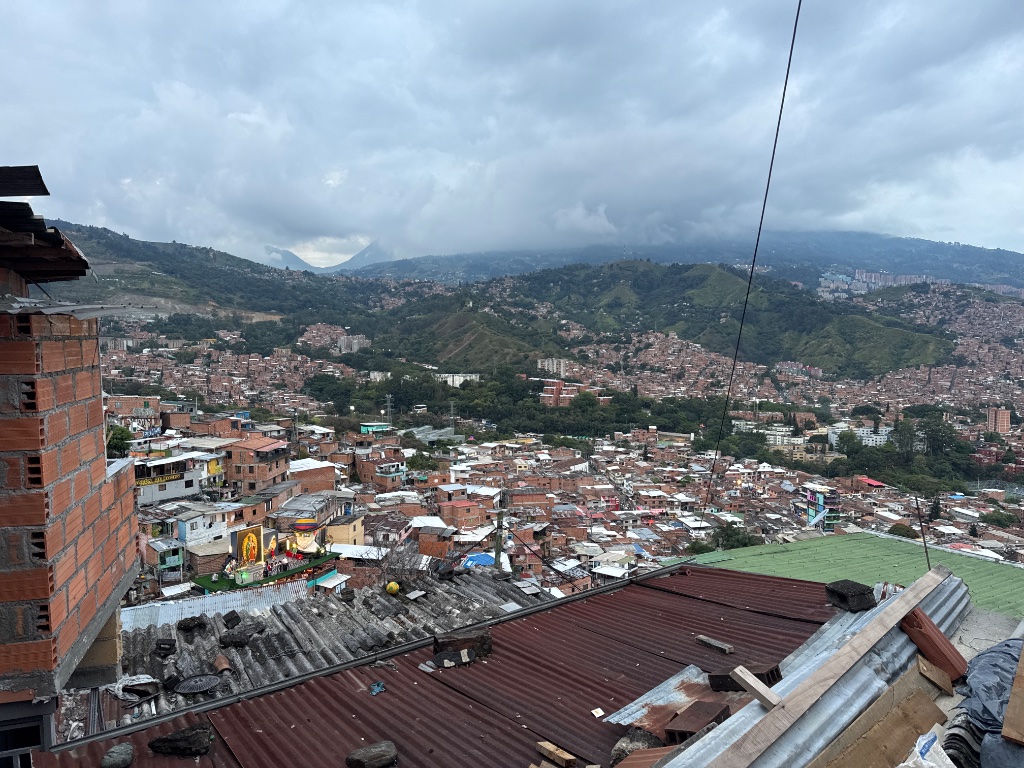
The hillside you are looking across is part of Comuna 13, a place that has undergone one of the most radical urban transformations in modern history. This neighborhood was once considered the most dangerous district in the world, caught in a multi-sided conflict between cartels, local gangs, and paramilitary groups. Today, it is a global symbol of social resilience and "social urbanism," where the city of Medellín used architecture and infrastructure to reclaim areas previously abandoned to violence.
One of the most striking features of this community is its verticality. Because the houses are built so densely on steep terrain, traditional streets often give way to narrow staircases and zig-zagging alleyways. To solve the problem of isolation, the city famously installed massive outdoor escalators just a short distance from here, which replaced a climb equal to that of a 28-story building and effectively "stitched" the community back into the rest of the city.
Looking closely at the rooftops and balconies, you’ll notice a large, brightly lit shrine featuring the image of a woman. This is a tribute to the Virgin of Guadalupe, a central figure in Catholic devotion throughout Latin America. In Colombian "barrios" like this one, such shrines are often community hubs rather than just private altars. They represent a blend of religious faith and a plea for protection in a place that has seen deep hardship. It is common for residents to maintain these shrines with fresh flowers and lights as a sign of collective hope.
The architecture itself tells a story of "informal" growth. Most of these houses are built from exposed red brick and corrugated metal sheets. For much of its history, this area grew without formal city planning; residents built their homes one room at a time, often starting with just a small brick foundation and adding levels as their families grew or as they saved enough money for more materials. The "unfinshed" look of many buildings—with rebar sticking out of the tops of walls—is actually intentional, allowing owners to easily add another floor in the future.
The lush green mountains in the distance provide a sharp contrast to the dense brick urban sprawl. These peaks are part of the Aburrá Valley, which cradles Medellín. While the valley's beauty is undeniable, the geography historically contributed to the social divide, as the wealthiest residents lived on the flat valley floor while the displaced and the working class were pushed higher and higher up these steep, difficult-to-service hillsides.
The Transformation of Comuna 13
Comuna 13 was once considered the most dangerous neighborhood in the world, serving as a strategic corridor for paramilitary, guerrilla, and cartel groups due to its location on the Medellín valley's edge. This history is marked by Operation Orion in 2002, a controversial military siege involving over 1,000 troops and helicopter gunships to oust rebel groups, resulting in numerous civilian casualties and disappearances.
Today, the area is a global model for "social urbanism." The outdoor electric escalators (escaleras eléctricas), spanning six sections, replaced 350 steep concrete stairs, drastically reducing commute times and physically integrating the marginalized community with the city center. The prominent shrine to the Virgin of Guadalupe reflects the deep-rooted Catholicism often intertwined with the neighborhood's resilience. The brick architecture is typical of mid-century informal settlements, where homes were built incrementally by residents using durable, affordable materials.
Comuna 13: Resistance and Urbanism
Comuna 13. Once the most dangerous neighborhood in the world, now a symbol of urban transformation. Heart of the "Operación Orión" (2002), a brutal military siege resulting in hundreds of "disappeared" civilians, many allegedly buried in "La Escombrera"—the mountain ridge visible in the distance.
The altar visible below is dedicated to the Virgin of Guadalupe, patroness of the Americas, reflecting the deep syncretism and religious resilience in informal settlements. The surrounding "favelas" display characteristic red brick (ladrillo), used for its low cost and thermal properties. These neighborhoods expanded through "auto-construcción" (self-building) by those displaced by Colombia's 60-year internal conflict.
Visible in the valley: Medellín’s Metrocable system, world-first mass transit via gondolas, designed to integrate marginalized hillside communities with the economic center. Nearby "Escaleras Eléctricas" (outdoor escalators) replaced hundreds of stairs, cutting commute times from 30 minutes to 6, a global case study in "social urbanism."