UG
Ulrich Gall
The Vertical Defiance of Comuna 13
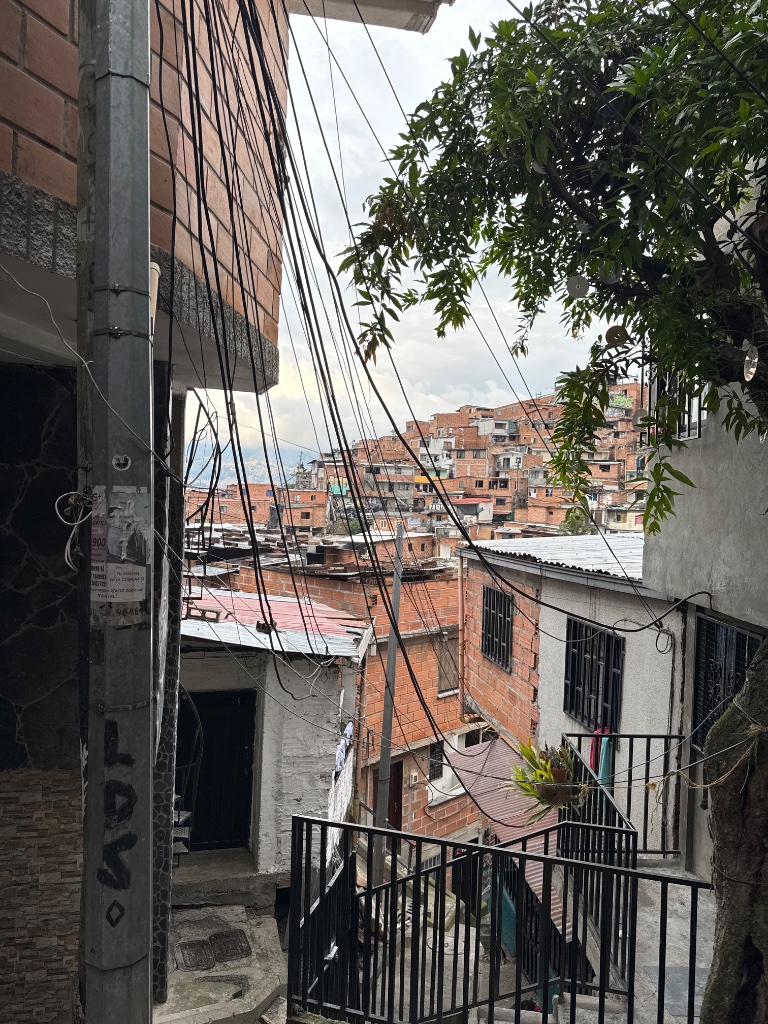
Here, in the steep, vertical labyrinths of Medellín’s Comuna 13, we see a profound struggle between human order and the chaotic indifference of the universe. The hillside is burdened with brick structures that cling to the earth like barnacles on a ship that is perpetually sinking, yet refuses to go under.
Observe the black cables—a tangled, sprawling nervous system. They stretch across the void in a desperate attempt to carry information, light, and power to souls living on these precipices. It is a web of human connectivity that looks as though it were spun by a spider suffering from a fever dream. These wires do not care for your aesthetics; they represent the raw, unyielding will to exist in a landscape that was once defined by its violence and isolation.
To the right, a tree grows under the weight of this gray sky, its leaves almost reaching out to touch the heavy concrete. It is a small, green defiance against the encroaching brick. This neighborhood, Las Independencias, was once a theater of great suffering, but now it has reinvented itself through art, through escalators that carry the weary upward, and through a communal spirit that is both beautiful and terrifying in its intensity.
There is a strange, overwhelming silence in the way these buildings look at one another over the narrow alleys. They stand in a kind of permanent witness to the history of the Aburrá Valley. One must wonder if the bricks ourselves are exhausted from holding up so much hope against the pull of gravity. It is a monumental achievement of the human spirit, and yet, it remains deeply rooted in the overwhelming mystery of our presence on this planet.
The Resilience of Comuna 13
The dense network of buildings and tangled utility lines seen here tells the story of one of the world’s most dramatic urban transformations. This neighborhood, Las Independencias within Comuna 13, was once considered the most dangerous district in Medellín and, by extension, one of the most volatile areas in the world. Its precarious position on the steep mountainside made it a strategic stronghold for various armed groups during the late 20th and early 21st centuries, as the narrow, winding alleys were nearly impossible for traditional law enforcement to navigate.
The architecture you see—brick structures tightly packed together—is characteristic of "informal settlements." These homes were often built by residents themselves using whatever materials were available, expanding upward and outward as families grew. Because this development happened outside of formal city planning, the electrical and telecommunications infrastructure often looks like a chaotic web of wires. These "tallarines" (noodles), as they are sometimes called, are a mix of official city connections and improvised hookups, as the community fought for decades to be recognized and integrated into the city’s essential services.
A major turning point for this area occurred around 2011 with the installation of a massive outdoor escalator system, located just steps away. This project was a global pioneer in "social urbanism," the idea that the best way to reduce violence is to provide dignity and mobility to the most neglected citizens. What used to be a thirty-minute climb up thousands of stairs became a six-minute ride, physically and metaphorically connecting the people of the hillside to the opportunities of the valley floor.
Today, the area is a vibrant center for street art, hip-hop culture, and neighborhood tours. The community initiative mentioned in the location data, "Sembradores de Amor" (Sowers of Love), is one of many local foundations that focus on social healing. They work to replace a history of conflict with a culture of peace and tourism, turning these once-feared alleys into an open-air museum of resilience. While the landscape still looks rugged and the wiring remains complex, it now stands as a symbol of how a city can reinvent itself through community-led design.
The Transformation of Comuna 13
This hillside neighborhood, Las Independencias in Comuna 13, was once considered the most dangerous district in the world. Historically a strategic corridor for guerrillas, paramilitaries, and drug traffickers due to its vantage points over Medellín, it underwent a radical transformation starting in 2011 with the installation of a 384-meter outdoor escalator system. This infrastructure bridged a climb equivalent to 28 stories, integrating the marginalized population into the city.
The "spaghetti" wiring common overhead highlights the area's history of informal settlement, where residents often improvised utility connections. Beneath the current vibrant street art and tourism lies a dark history; notably Operation Orion in 2002, a controversial military raid involving 3,000 troops that resulted in numerous forced disappearances. Many victims are believed to be buried in "La Escombrera," a nearby construction dump that serves as one of the largest mass graves in the country.
Comuna 13’s Vertical Transformation
Commonly dubbed the "Miracle of Medellín," Comuna 13—specifically the Las Independencias neighborhood—was once the most dangerous district in the world’s most dangerous city. It served as a strategic corridor for paramilitary, guerrilla (FARC/ELN), and cartel factions trafficking drugs and arms due to its steep, labyrinthine geography.
The massive orange-brick density reflects informal "autoconstrucción" (self-building). Residents often tapped illegally into the power grid, resulting in the chaotic "spaghetti" wiring seen overhead. The district’s transformation pivoted on "Social Urbanism," exemplified by the nearby outdoor orange-roofed escalators (*escaleras eléctricas*) installed in 2011. This replaced a 35-minute vertical climb with a six-minute ride, physically integrating marginalized citizens into the city.
Note the "La Escombrera" area in the distance: a former rubble dump suspected of being the continent’s largest urban mass grave, holding hundreds of victims from Operation Orion (2002), a controversial military raid to purge militias. Today, the area is a global hub for street art and hip-hop culture, used as peaceful resistance against its violent history.