UG
Ulrich Gall
The Human Antthill of Comuna 13
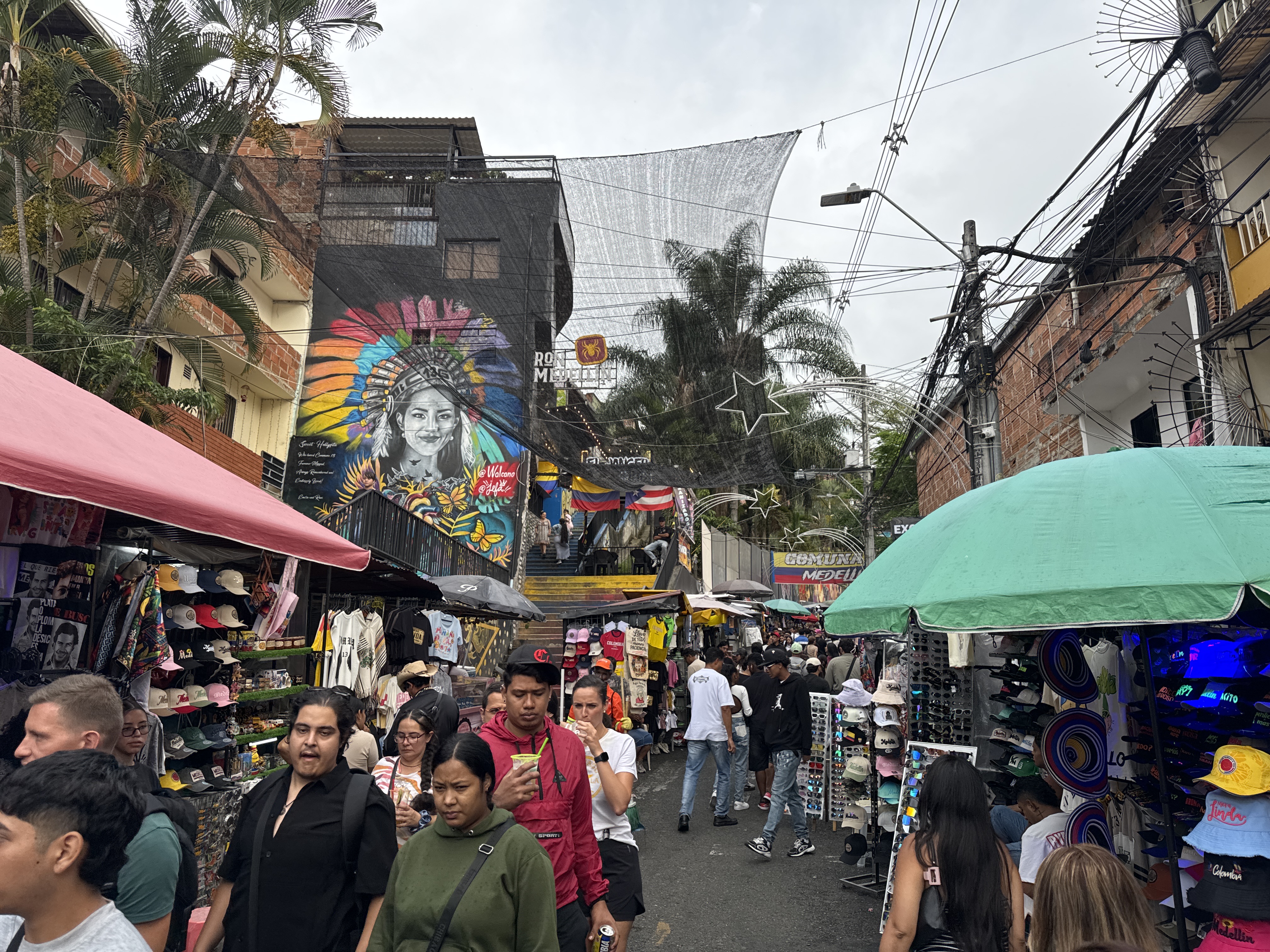
Here, in the steep labyrinth of Medellín’s Comuna 13, we see a human anthill of staggering proportions. Once a theater of profound darkness and violence, the hillside has transformed into a fever dream of commerce, color, and the relentless noise of survival. It is a spectacle of the overwhelming absurdity of human resilience.
We observe the tourists, drifting like heavy-eyed cattle through narrow passages, past stalls overflowing with cheap plastic artifacts and hats that will eventually be forgotten in a dusty closet in Dusseldorf or Ohio. They move beneath an intricate web of electrical wires—a chaotic, black lace that hangs above the street, threatening to collapse or perhaps to strangle the very sky in its frantic quest to deliver power to a thousand speakers playing reggaeton.
The walls here do not speak; they scream. The vibrant mural of an indigenous woman stares out with a gaze that is both haunting and indifferent to the capitalist ecstasy unfolding at her feet. She is a silent witness to the metamorphosis of a neighborhood that was once the most dangerous place on this indifferent planet, now paved with the footsteps of those seeking "authentic" experiences and fruit juices served in plastic cups. Above, the netting stretches across the alley like a giant, metaphorical spiderweb, catching not flies, but the fleeting curiosities of the masses.
There is an ecstatic truth in this chaos—a reminder that even in the shadows of a brutal history, man will find a way to sell a souvenir and walk toward the summit of a hill, oblivious to the monumental struggle of the concrete that holds him up.
The Transformation of Comuna 13
What was once one of the most dangerous neighborhoods in the world has transformed into a vibrant cultural epicenter where street art serves as a powerful tool for social healing. This bustling walkway is a gateway into Comuna 13, a district in Medellín that has reinvented itself through "urban socialismo"—the idea that the most beautiful infrastructure should be placed in the most marginalized areas.
The striking mural dominating the black building features a woman in an indigenous headdress, a common motif in Colombian street art that honors the country's multi-ethnic roots. The text "Welcome to Jelly" refers to a local business or social project, typical of the entrepreneurial spirit found here. You’ll notice the Colombian flag—yellow, blue, and red—draped proudly near the stairs, alongside the flag of Medellín. These stairs lead toward the famous outdoor electric escalators, which were installed in 2011. Before they existed, residents had to climb the equivalent of 28 stories on foot just to reach their homes, a physical barrier that contributed to the area's historical isolation.
The canopy of mesh and hanging star decorations overhead serves a dual purpose: providing shade for the vendors selling souvenirs and "micheladas," and creating a festive atmosphere for the "Graffiti Tour" participants who visit daily. This alleyway is a place where former gang members now earn a living as artists, dancers, and guides, using the murals to tell the story of "Operation Orion"—a controversial 2002 military raid—and the subsequent peace that the community built for itself. It is a living museum of resilience, where hip-hop culture and art have quite literally replaced gunfire.
Comuna 13's Transformation
Comuna 13 was once the most dangerous neighborhood in the world’s most dangerous city. During the 1980s and 90s, its position on the hills of western Medellín made it a strategic corridor for drug cartels and paramilitary groups moving contraband out of the Aburrá Valley.
The neighborhood's history is defined by **Operation Orion** in 2002, a massive, controversial military raid involving helicopters and heavy artillery aimed at rooting out left-wing guerillas. While the state reclaimed control, hundreds of civilians "disappeared," and many are believed to be buried in *La Escombrera*, a nearby construction landfill that remains one of the largest mass graves in South America.
Today, the district is a global model for "social urbanism." The outdoor electric escalators (visible further up the slope) replaced a 35-minute uphill climb with a six-minute ride, physically integrating the marginalized community into the city. Much of the graffiti, like the vibrant mural of the indigenous woman, serves as "artistic resistance," used by locals to reclaim their narrative and pay tribute to victims of the conflict while preventing gangs from reclaiming territory through tagging.
Comuna 13’s Resilience and Graffiti
Comuna 13 was once Medellín's most dangerous neighborhood, a strategic corridor for paramilitary, guerrilla, and cartel groups moving drugs and weapons due to its hillside position. The 2002 "Operación Orión"—a controversial military raid—marked a violent turning point, resulting in numerous disappearances and civilian casualties.
The vibrant street art today isn't just decoration; it’s a form of "artivism" used to reclaim territory from gangs. Murals often feature heavy symbolism: birds (peace), portraits of lost loved ones, and eyes (vigilance against a return to violence). Those outdoor escalators nearby? They were a world-first social urbanism project, replacing 350+ stairs to integrate this marginalized community with the city center. Despite the tourist influx, some "invisible borders" remain—unspoken lines controlled by local *combos* (gangs) that residents know not to cross, though tourists are generally protected as a valuable revenue source.