
Elisabeth de Kleer
The Skeletal Sentinels of Alameda Point
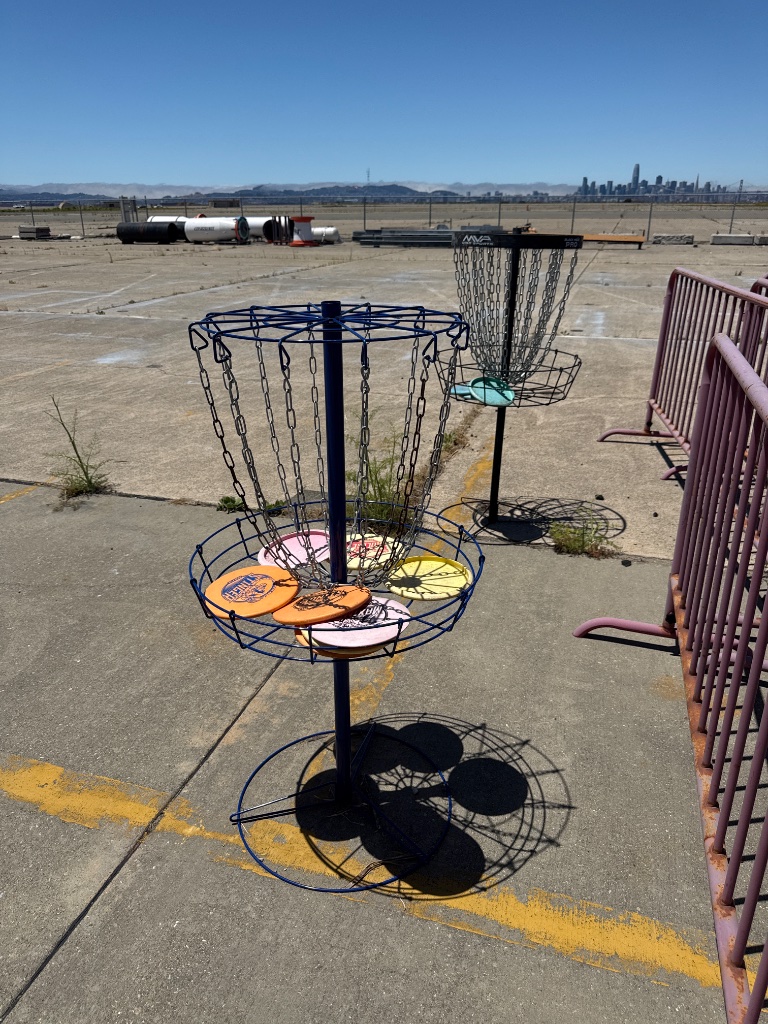
Here, on the edge of a desolate naval wasteland in Alameda, we bear witness to a strange, metallic ritual. These devices are disc golf baskets—skeletal sentinels of a sport that mocks the very concept of efficiency. They stand upon the cracked pavement of the former Naval Air Station, where once massive engines of war roared toward the horizon, and now there is only the indifferent wind and the hollow clinking of chain against steel.
Observe the construction: a central pillar of blue-painted iron, supporting a crown of chains designed to catch a flying plastic projectile. It is a trap with no teeth, a cage for a bird that does not exist. The discs themselves—vibrant oranges, pale pinks, and sickly yellows—lie trapped in the basket’s lower maw. They are objects of aerodynamic obsession, flung by humans who seek a momentary sense of trajectory in a world that is otherwise aimless and chaotic.
The backdrop reveals the San Francisco skyline, shimmering in the distance like a fever dream of progress. But here, on the concrete, the reality is more stark. These baskets—specifically models like the blue one in the foreground and the silver MVP Black Hole Pro behind it—are portable. They are transients, much like the people who play here. To play disc golf in such a landscape is to engage in a profound struggle against the elements; the salt air corrodes the metal, and the relentless sun beats down upon the plastic, slowly reclaiming these artifacts back into the indifference of the universe. It is a beautiful, pointless endeavor, played on the graveyard of a superpower.
Disc Golf Targets on the Alameda Tarmac
These portable metal baskets are targets for disc golf, a sport played much like traditional golf but with aerodynamic "discs" rather than balls. The chains are designed to intercept the speed of a flying disc, causing it to lose momentum and drop into the basket below (a "holing out").
Unlike recreational Frisbees, these competitive discs are smaller, heavier, and have sharper edges for greater distance and stability. They are categorized by flight characteristics: drivers (high speed, aerodynamic), mids, and putters (blunt edge, slower). One disc visible is a "Stinger," a vintage model by Discraft.
This specific location—the former Naval Air Station Alameda—has become a cultural hub. While most of the tarmac serves as a massive event space or movie set (including *The Matrix Reloaded* car chase), it often hosts temporary disc golf setups or "pop-up" courses. Nearby, the "Spirits Alley" district features several breweries and distilleries that lean into the relaxed, outdoorsy subculture often associated with disc golf in California.