UG
Ulrich Gall
Sentinels of the Pacific at Coast Guard Island
The United States Coast Guard’s Pacific fleet is headquartered right here on an island known as Coast Guard Island, a 68-acre man-made landmass tucked into the Oakland Estuary. While it might look like just another part of the waterfront, this specialized military base is the home port for some of the most advanced national security cutters in the world.
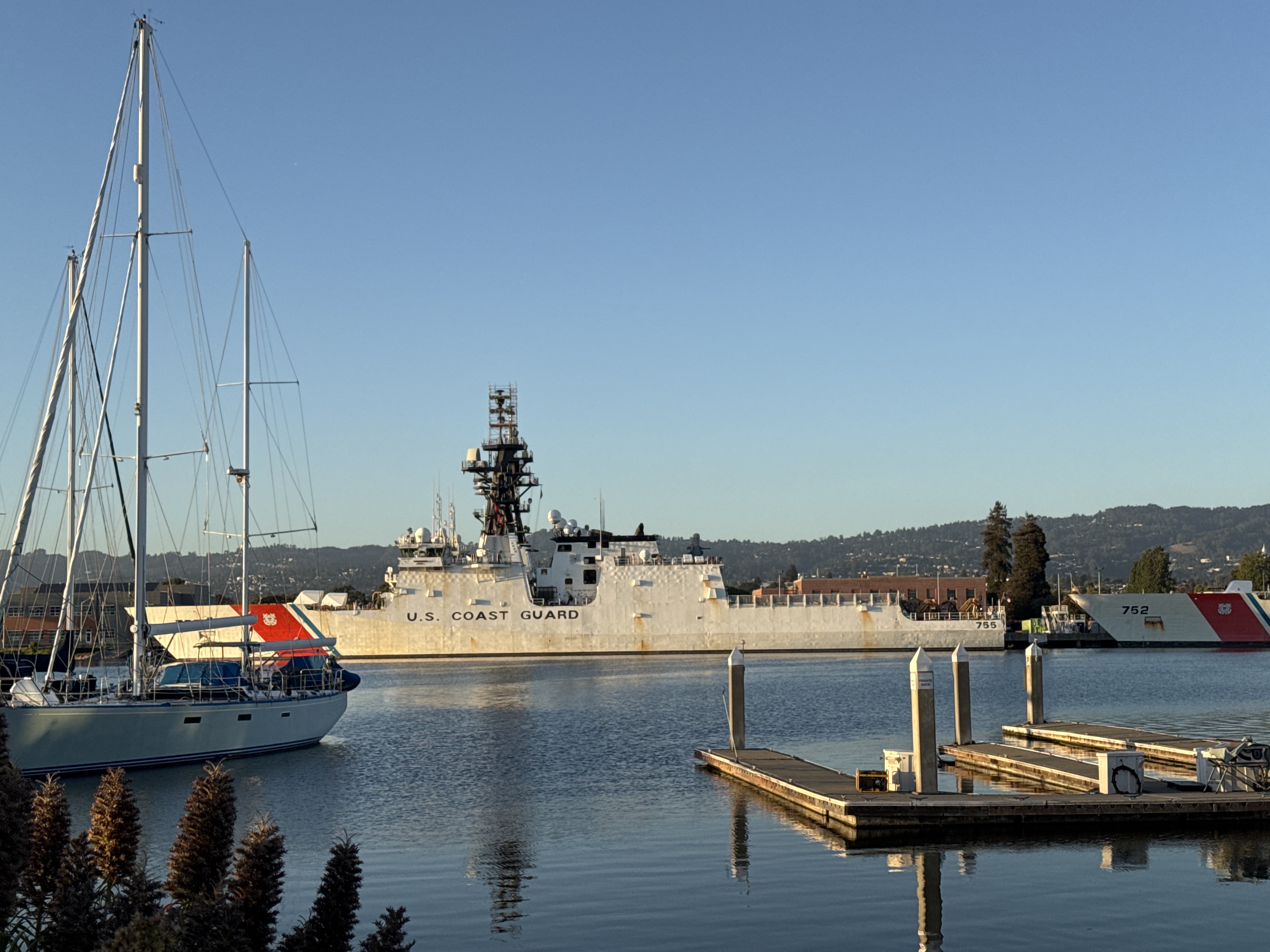
The prominent white vessels with the distinctive orange and blue diagonal "racing stripes"—a brand identity adopted by the Coast Guard in the 1960s to make their ships easily recognizable worldwide—are Legend-class cutters. The ship numbered 755 is the USCGC Munro, and visible nearby is the bow of ship 752, the USCGC Stratton. These aren't just harbor patrol boats; they are high-endurance warships designed for grueling missions that can last months. They are frequently deployed far from California, patrolling the waters of the Arctic to monitor changing ice conditions or operating near Southeast Asia to enforce international maritime law.
What makes this specific location interesting is its history. The island was originally a marshy area that was built up using mud and silt dredged during the expansion of the Oakland harbor in the 1910s. During World War II, it served as a massive training center where tens of thousands of recruits were processed for the war effort. Today, it remains one of the Coast Guard's most vital hubs, acting as a small city with its own medical clinics, industrial shops, and housing. Because it is a federal military installation, the island itself is restricted, making this view from the Alameda marinas one of the best ways for civilians to see these massive national security assets up close before they head out to the open Pacific.
High-Stakes Cutters of Coast Guard Island
Coast Guard Island, located in the Oakland Estuary, serves as the primary West Coast hub for the U.S. Coast Guard’s Pacific Area command. This high-security installation is the homeport for several Legend-class National Security Cutters (NSCs), identified by their 418-foot length and hull numbers beginning with 75.
These vessels are the most technologically advanced in the fleet, designed for long-range missions such as counter-narcotics, maritime intercept, and national defense. Specifically, the USCGC Munro (WMSL-755) and USCGC Stratton (WMSL-752) are often docked here. Each is equipped with a flight deck, state-of-the-art signals intelligence hardware, and a 57mm Mk 110 gun capable of firing 220 rounds per minute. While the Coast Guard is part of the Department of Homeland Security during peacetime, these specific ships are "interoperable" with the U.S. Navy, allowing them to serve in high-threat combat environments globally.
Legend-Class National Security Cutters
Legendary cutters moored at Coast Guard Island in the Oakland Estuary. Visible are the USCGC *Munro* (WMSL-755) and the bow of USCGC *Stratton* (WMSL-752). These are Legend-class National Security Cutters (NSCs), the centerpiece of the U.S. Coast Guard’s fleet at 418 feet long.
Engineered for high-endurance missions: drug interdiction in the Eastern Pacific, fisheries enforcement, and national defense near sensitive zones like the South China Sea. Equipped with a Bofors 57 mm gun and Phalanx CIWS (Close-In Weapon System) for anti-ship missile defense. The flight deck supports MH-65 Dolphin helicopters and long-range drones.
Coast Guard Island, a man-made 67-acre landform, serves as the primary West Coast hub. While the USCG is under the Department of Homeland Security, these ships integrate directly with Navy strike groups during wartime. The *Munro* famously gained notoriety for a 2019 viral video showing a crew member jumping onto a moving "narco-sub" (SPSS) to force it open—a high-stakes maneuver common for these Alameda-based crews.