UG
Ulrich Gall
The Essence of Taste in Panama's Barrio Chino
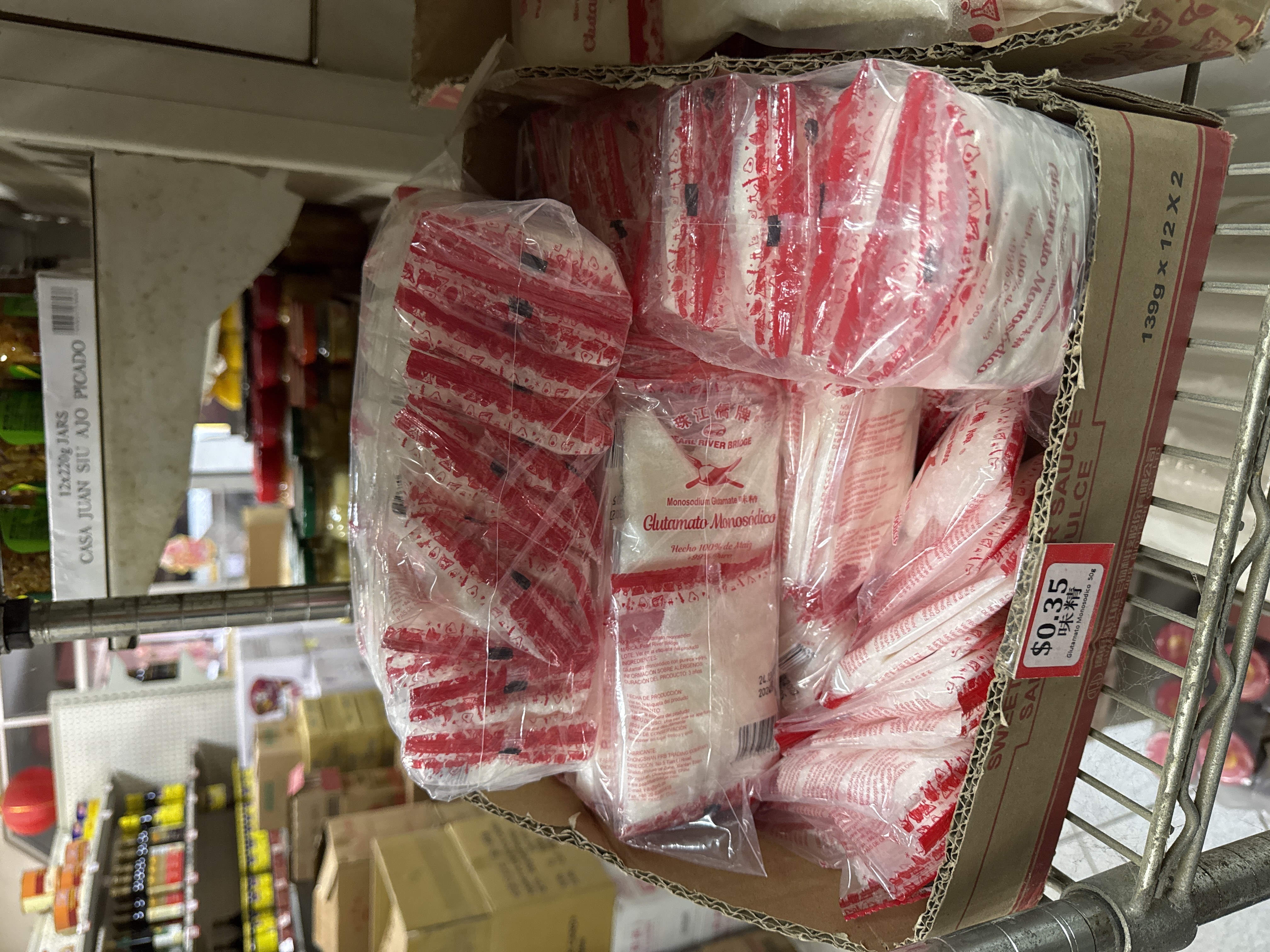
Panama City is home to one of the oldest and most influential Chinese communities in Latin America, and these small packets of "Glutamato Monosódico"—better known as MSG—are a staple ingredient that bridges the gap between traditional Cantonese flavors and modern Panamanian cuisine. While the red and white packaging might look like sugar or salt to an outsider, the label "味精" (wèijīng) identifies it as the essential "essence of taste" that provides the savory umami profile found in everything from local stir-fries to the snacks sold at neighborhood "chinitos," the ubiquitous corner stores often run by Chinese-Panamanian families.
The presence of brands like "Pearl River Bridge" highlights the deep historical ties between Panama and South China, specifically the Guangdong province. The Chinese first arrived in significant numbers in the 1850s to work on the Panama Railroad and later the Canal. Over the generations, they moved from being manual laborers to becoming the backbone of the country’s retail and grocery sector. Today, the Barrio Chino, or Chinatown, in the Santa Ana district acts as a bustling wholesale hub where you’ll find these imported goods sold alongside boxes of "Ajo Picado" (minced garlic) by local Chinese-Panamanian distributors like Casa Juan Siu.
For a visitor from Europe or North America, seeing MSG sold so prominently and cheaply—just 35 cents here—might be surprising given the "MSG-free" marketing common in Western health food aisles. However, in Panama and much of Asia, MSG is treated as a standard seasoning no different from pepper. It is particularly crucial in the fusion of cultures found here; for instance, many "typical" Panamanian dishes, such as fried rice (arroz chaufa) or certain meat preparations, have been permanently reshaped by Chinese flavor profiles, making this white crystalline powder a quiet but powerful architect of the local palate.
The Science of Umami in Barrio Chino
Monosodium glutamate (MSG), labeled here as "Glutamato Monosódico," is the pure sodium salt of glutamic acid, an amino acid naturally present in tomatoes, parmesan, and mushrooms. While Western culinary myths in the late 20th century associated it with "Chinese Restaurant Syndrome," peer-reviewed double-blind studies have consistently failed to find a causal link between MSG consumption and those reported symptoms.
In Panama, the Chinese community has a deep history dating back to 1854 with the construction of the Panama Railroad. This "Barrio Chino" (Chinatown) in the Santa Ana district is the historic heart of that community. The brand seen here, Pearl River Bridge, is a major state-owned exporter from Guangdong, China. Sold in small, inexpensive packets, MSG is used as a foundational seasoning in local "Chino-Panameño" cuisine to provide "umami"—the fifth basic taste that signals the presence of proteins to the brain.
Pure Umami: The MSG Myth vs. Reality
Bulk Monosodium Glutamate (MSG), or *glutamato monosódico*. Pure umami—the "fifth taste" found naturally in tomatoes and parmesan. Often stigmatized in the West due to "Chinese Restaurant Syndrome," a 1960s myth debunked by modern science; MSG is generally recognized as safe (GRAS) by the FDA. Chemically, it’s a sodium salt of glutamic acid.
These 50g sachets are from the Pearl River Bridge brand, a massive Chinese state-owned exporter. In Panama's Barrio Chino, MSG is a staple ingredient for both the local Chinese community (dating back to the 1850s canal labor) and traditional Panamanian "fondas" to deepen the savory profile of stews and rice. Sold here for $0.35—remarkably cheap flavor enhancement. Unlike table salt, it contains 1/3 less sodium, potentially making it a healthier alternative for seasoning.