UG
Ulrich Gall
The Gateway of the Hok Shan Society
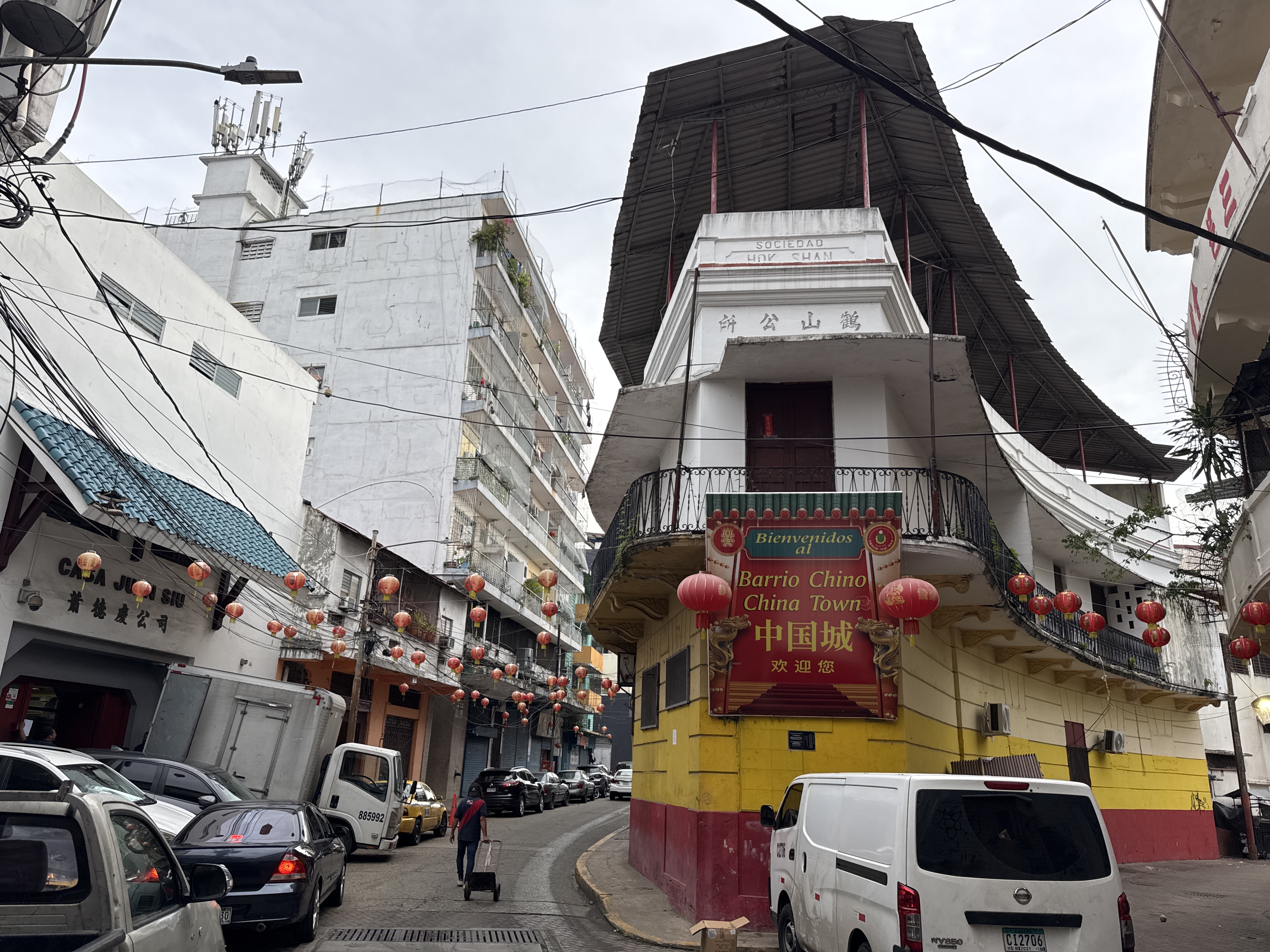
Panama City’s Barrio Chino is one of the oldest and most significant Chinese enclaves in Latin America, serving as the historical gateway for a community that has deeply influenced Panamanian culture for over 170 years. The distinctive wedge-shaped building marking this corner is the headquarters of the Sociedad Hok Shan, a "huiguan" or benevolent association.
Benevolent associations like this were established by early Chinese immigrants to provide a support network for newcomers who spoke the same dialect or hailed from the same region in China—in this case, the Hok Shan (He Shan) district of Guangdong province. The facade features Chinese characters (鶴山公所) which translate to "Hok Shan Public Office." These societies acted as social clubs, housing registries, and even welfare offices, helping immigrants navigate life in a Spanish-speaking country while maintaining their ancestral traditions.
The presence of this vibrant neighborhood in Central America is a direct legacy of the massive infrastructure projects of the 19th century. Thousands of Chinese laborers were recruited to work on the Panama Railroad in the 1850s, and later, the French and American attempts to build the Panama Canal. Today, the Chinese-Panamanian community is one of the largest in the region. You can see the blend of cultures in the signage, where Spanish greetings like "Bienvenidos al Barrio Chino" sit alongside "Zhongguo Cheng" (中国城), which literally means "China City."
This specific area, located on the edge of the historic Casco Viejo district, retains an authentic, gritty charm that stands in contrast to the polished tourist zones nearby. It is a hub for wholesale trade and traditional cuisine. If you look closely at the upper floor of the Hok Shan building, you’ll notice a large corrugated metal roof hovering over the original structure. This is a common local adaptation to Panama's intense tropical downpours, creating a "double roof" that protects the masonry and helps keep the interior cool in the sweltering heat.
The Silent Sentinels of Panama's Barrio Chino
Panama City’s Barrio Chino is one of the oldest Chinese neighborhoods in Latin America, established primarily by Yue-speaking migrants from Guangdong who arrived in the mid-19th century to build the Panama Railroad and later the Canal. The distinctive building at the fork is the **Sociedad Hok Shan** (鹤山公所), a traditional benevolent association founded by immigrants from Heshan, China. These clans or "tongs" provided social safety nets, housing, and legal protection for laborers who faced systemic discrimination and "yellow peril" exclusion laws in Panama during the early 1900s.
The neighborhood sits within the border of Santa Ana, historically the working-class suburb outside the elite colonial walls of Casco Viejo. While the district underwent significant decay in the late 20th century, it remains the spiritual center for Panama's Chinese community, which accounts for roughly 4% to 5% of the national population—the largest per capita in Central America. The "flat-iron" architecture of the Hok Shan building is a pragmatic colonial adaptation to Panama's narrow, radiating street grids, often topped with corrugated metal "double roofs" to combat the intense tropical heat and rainfall.
The Clan Houses of Barrio Chino
Sociedad Hok Shan building. Heart of Panama City's Barrio Chino. Panama has the largest Chinese community in Central America, dating back to 1854 labor for the Panama Railroad, then the Canal.
This specific curved "flatiron" building is a clan association house (huiguan). Note the Chinese characters: 鶴山公所 (Hok Shan Kung Soh). It serves immigrants from Heshan, Guangdong. These associations historically provided housing, job placement, and funeral services for bachelor laborers. Today, they function as social clubs and clandestine mahjong dens.
Neighborhood serves as a hub for "Chifa" (Chinese-Peruvian fusion) and traditional Cantonese dim sum. Paradoxically located inside the historic Santa Ana district, which neighbors the high-end Casco Viejo but remains gritty, plagued by "red zones" and gang presence. The Esoterica shops nearby sell *botánica* supplies: ritual candles, "follow me" oils, and santería charms, blending Chinese mercantilism with Afro-Panamanian mysticism.