UG
Ulrich Gall
The Coati Smorgasbord of Albrook
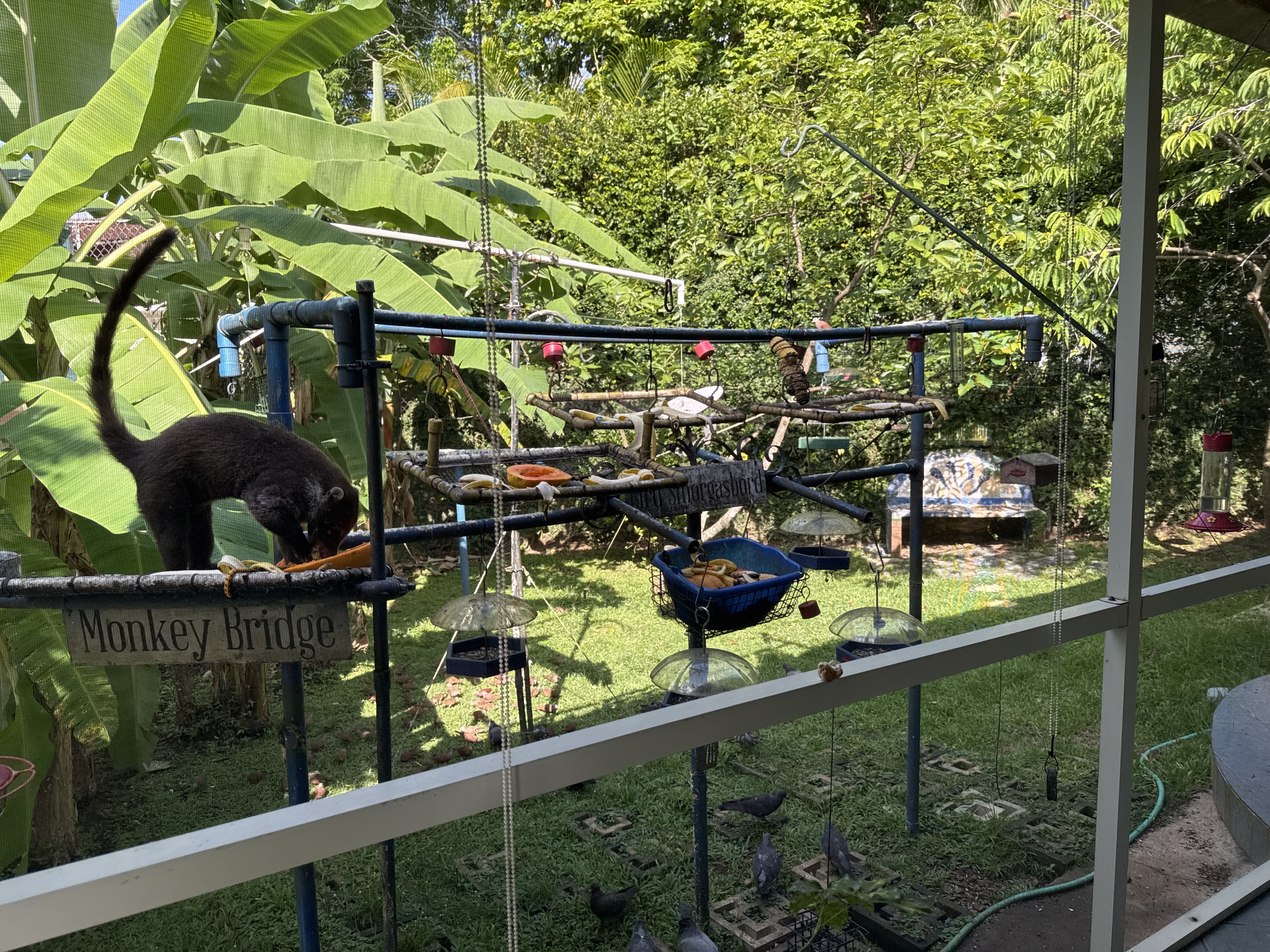
Here, amidst the lush and indifferent greenery of Albrook, we bear witness to a strange architecture of human intervention. It is a contraption of pipes and platforms—a "Monkey Bridge"—constructed as a desperate peace treaty between the civilized world and the chaotic hunger of the jungle.
The creature traversing this blue-painted labyrinth is the Coati—or *Nasua narica*—a relative of the raccoon, though possessed by a much more frantic, existential drive. Notice its long, searching snout, a tool designed by evolution to poke into the dark, indifferent crevices of the earth, and its tail, held aloft like a question mark in a world that offers no answers. It does not care for the whimsy of the sign. It cares only for the papaya and the banana, the sweet, rotting sugars that provide a fleeting reprieve from the overwhelming struggle of survival.
This "Smorgasbord" is a theater of the absurd. Below, the pigeons congregate like gray, feathered bureaucrats, waiting for the crumbs of a higher order to fall from the Coati's table. There is no harmony here, only a temporary truce dictated by the availability of tropical fruit. The jungle watches from the periphery, ancient and silent, ready to reclaim these blue pipes the moment the humans stop replenishing the nectar. It is a profound and slightly ridiculous spectacle of nature being seduced by a garden hose and a wooden sign.
The Backyard Smorgasbord of Albrook
While it looks like a scene out of a tropical storybook, the curious creature exploring this elaborate backyard feeding station is a White-nosed Coati, known locally in Panama as a *gato solo*. Despite that nickname, which translates to "lone cat," these animals are actually members of the raccoon family. This particular individual is taking advantage of a "Monkey Bridge," part of a creative "Smorgasbord"—as the signs in the garden suggest—designed to support the diverse wildlife that thrives in the Albrook area.
Albrook is a unique residential neighborhood because it was formerly a United States Air Force base. When the Canal Zone land was transferred back to Panama, the area’s lush, jungle-like environment was preserved, allowing wildlife to live right alongside residents. This habituated coati is likely a regular visitor. You can tell it’s a coati by its long, ringed tail, which it often holds upright like a flagpole for balance or to help members of its troop keep track of one another in tall grass. Their long, flexible snouts are incredibly sensitive, capable of rotating 60 degrees to poke into crevices for insects, though they certainly won't turn down a slice of papaya or banana from a friendly neighbor.
The setup here is a great example of "urban ecology" in Panama. Because Albrook borders the Metropolitan Natural Park and the Camino de Cruces National Park, it serves as a biological corridor. The bridge structure helps keep animals safe and off the ground, where they might encounter domestic pets or cars. While the sign says "Monkey Bridge," and you might indeed see Geoffroy’s tamarin monkeys or Capuchins passing through, the coati’s dexterity makes it a master of these elevated highways. Just be careful if you encounter one closer; while they look cute and curious, they have sharp claws and teeth, and as their "lone" nickname suggests, older males can be quite solitary and protective of their space.
The Caribbean Coati of Albrook
The animal scavenging on this platform is a White-nosed Coati (*Nasua narica*), known locally in Panama as a *gato solo*. Despite the sign labeled "Monkey Bridge," coatis are actually members of the procyonid family, making them close relatives of raccoons rather than primates.
They are highly intelligent, opportunistic omnivores with a distinctively long, ringed tail used for balance and a flexible, hog-like snout designed for rooting through leaf litter. In residential areas like Albrook—a former U.S. Canal Zone neighborhood integrated into the tropical forest—coatis have become strikingly bold. While they typically live in large female social groups called bands, adult males are often solitary, which led to the Spanish name *gato solo* (lone cat).
A key behavior to note is their habit of descending trees head-first; they possess specialized ankles that can rotate beyond 180 degrees, allowing them to climb down vertically with ease. Although they appear docile while feeding on fruit or scraps, they possess sharp canines and powerful claws. In Panama, they are known to harbor various parasites and can occasionally transmit rabies, so maintaining distance is advised despite their habituation to humans.
Coati at the Monkey Bridge
White-nosed Coati (*Nasua narica*), locally called "gato solo." Procyonids, related to raccoons but diurnal and highly social (females/young live in "bands"). Males are often solitary. Features: long, ringed tail used for balance; flexible, pig-like snout for rooting insects/tubers; strong claws for climbing.
Highly opportunistic omnivores. In Albrook—a former US Canal Zone residential area—they are acclimated to humans. While cute, they possess sharp canines and can be aggressive if cornered or competing for food. They are notorious "trash pandas" of the tropics, raiding kitchens and bird feeders.
Feeding wildlife in Panama is controversial. It causes "habituation," leading coatis to lose fear of humans, which often results in property damage or bites requiring rabies protocols. They also transmit parasites like *Trypanosoma cruzi* (Chagas disease). The Albrook/Ancón area is a biological corridor; frequent interactions with Toucans, Sloths, and Geoffroy’s Tamarins (the likely targets of the "Monkey Bridge") are standard here due to the proximity to Soberanía National Park.