TF
Tobin Fricke
The Strategy of the Streets: Xiangqi in the Park
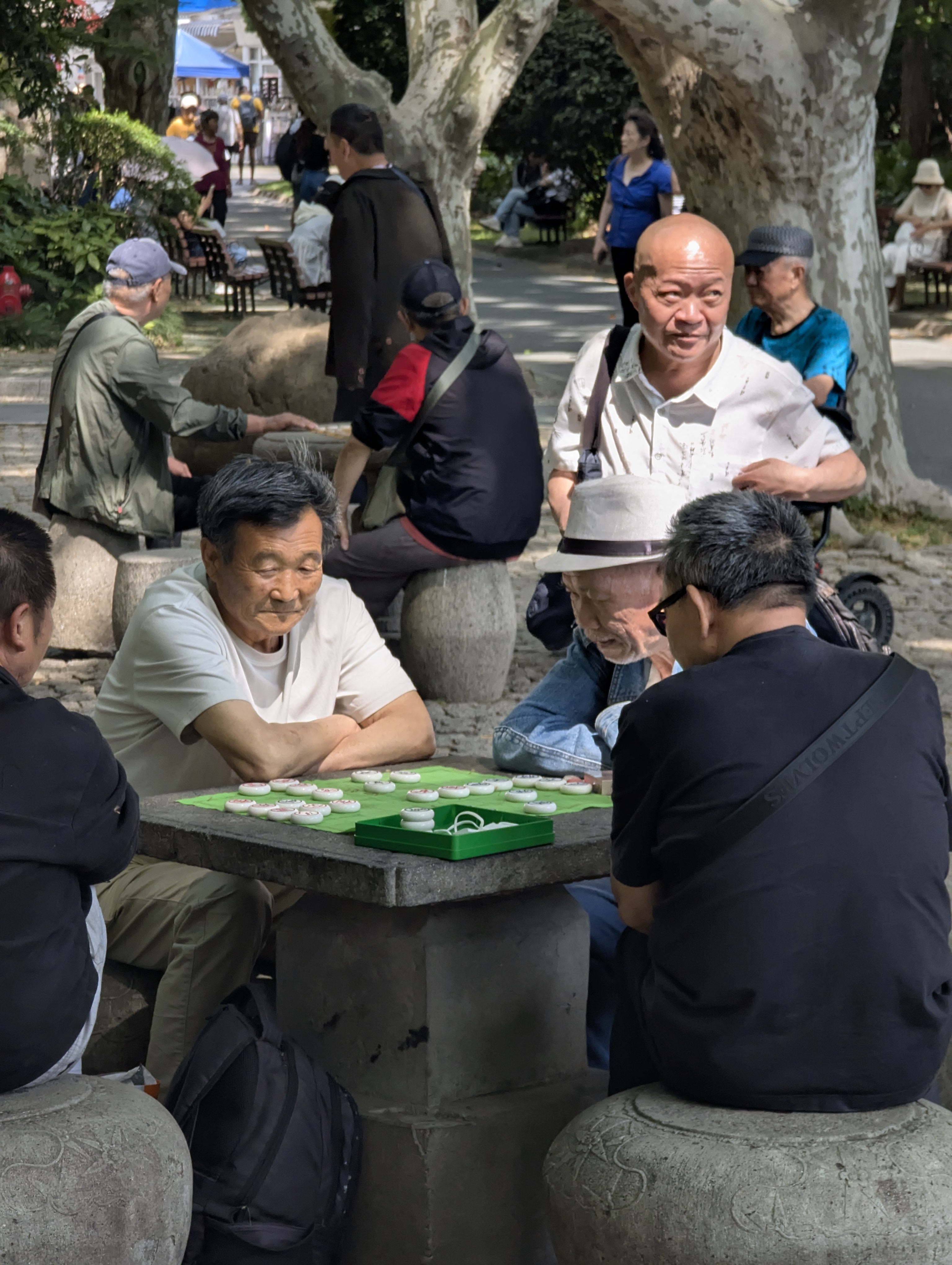
The game being played here is Xiangqi, often called Chinese Chess, and it is a cornerstone of social life in public parks across East Asia. Unlike the Western version of chess, Xiangqi represents a battle between two armies across a specific landscape of a river and a palace, and it has been played in various forms for over a thousand years.
One of the most distinctive features you’ll notice is that the pieces—those flat, circular discs marked with red or black Chinese characters—do not sit inside the squares of the board. Instead, they are placed on the "intersections" where the lines meet, much like in the game of Go. If you look closely at the green mat, you’ll see a blank horizontal space in the middle. This represents the "Chu River" or the "Han Border," a historical reference to the Chu-Han Contention in the 3rd century BCE. Certain pieces, like the elephants, are not allowed to cross this river; they are strictly defensive units. Meanwhile, the most important piece—equivalent to the King—is confined to a small square at the back called the "Fortress" or "Palace," and is never allowed to leave its bounds.
While the game itself is highly strategic and quiet, the atmosphere surrounding it is anything but solitary. In many urban centers, these outdoor matches are a vital "third space" for the elderly. You will frequently see a crowd of "kibitzers" or onlookers hovering over the players. In this culture of street play, it is perfectly normal and even expected for bystanders to offer unsolicited advice, groan at a bad move, or argue over the best strategy. It transforms a mental duel into a rowdy, communal performance.
The characters on the pieces are often slightly different for each side to help players distinguish them. For example, the "General" on the black side might use a different character than the "General" on the red side, even though they function identically. This is a game where the sounds are as important as the sights; specifically, the "clack" of the heavy acrylic or wooden stone being slammed onto the stone table is a satisfying declaration of a decisive move.
The Strategy of Xiangqi in the Park
Xiangqi (Chinese Chess). Ancient strategy game dating back to the 4th century BC; highly popular in public parks across East Asia. Unlike Western Chess, pieces move on intersections (lines) rather than squares. The board is divided by a "River," which restricts certain pieces and enhances others.
Key pieces and mechanics:
* **General (King):** Restricted to a 3x3 "Palace"; cannot face the opposing General directly on an open file.
* **Cannon:** Moves like a Rook but must hop over exactly one "screen" (any piece) to capture a target.
* **Elephant:** Defensive piece that cannot cross the River.
* **Advisors:** Stay within the Palace to protect the General.
Common sight: "Street side masters" playing for small wagers, though gambling is technically illegal. The intense spectators often engage in "kibitzing," offering loud, unsolicited advice. The green mats and weighted plastic pucks are standard for outdoor play due to durability.
Location information is still being resolved.