TF
Tobin Fricke
The Crimson Sentinel of Shanghai
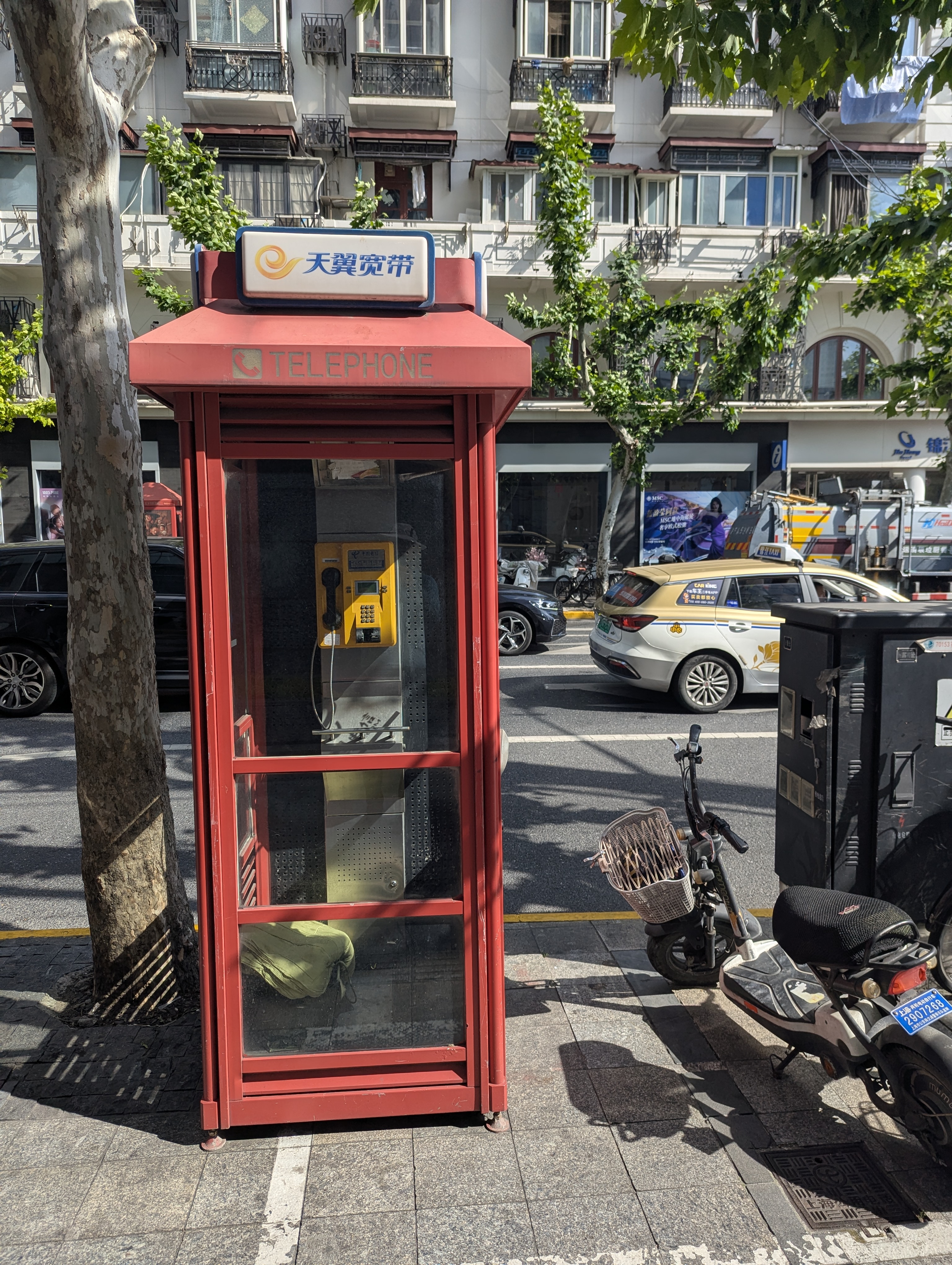
Here, in the sprawling indifference of the urban landscape, we find a curious artifact of a bygone era. A red telephone booth stands like a lonely sentinel, a crimson monolith of communicative despair. It is an echo of a time when men and women had to commit themselves to a physical space to project their voices into the void.
Look closely at the yellow apparatus within its glass ribcage. It is the "Tianyi Broadband" (天翼宽带) public telephone, a species that was once dominant but is now facing a slow, digital extinction in the streets of Shanghai. It does not possess the sleek, cold intellect of the smartphone; it is a clunky, mechanical beast, rooted to the concrete, waiting for a finger to press its buttons in a frantic search for connection.
There is a profound sadness in the way it stands next to the plane tree, while the relentless flow of electric scooters and modern taxis—symbols of our frantic need to be elsewhere—rushes past it without a glance. Even the sign atop it, an advertisement for broadband, suggests a desperate attempt to adapt to a world that has moved into the invisible realms of Wi-Fi. It remains a shelter for the weary, or perhaps a confessional for the desperate, where one might still dropped a coin and hear the hollow hum of the dial tone—the sound of the universe reminding us that, in the end, we are all just shouting into the dark.
Shanghai's High-Tech Red Telephone Booths
While this classic red telephone booth might remind you of the streets of London, it is actually a high-tech cultural icon of Shanghai. These booths are a nostalgic nod to the city’s colonial-era history, specifically the French Concession, where European-style architecture and plane trees—like the one standing right next to it—create a unique atmosphere. However, beneath the vintage red paint and the English "TELEPHONE" sign, these booths have been completely reinvented for the digital age.
The logo at the top, "天翼宽带" (Tiānyì Kuāndài), belongs to China Telecom, the state-owned giant that operates these pods. In a city where almost everyone carries a smartphone, these booths were facing extinction until the city decided to turn them into "Digital Telephone Booths." They no longer just house a simple payphone; they now serve as essential urban infrastructure. Most of these units act as 5G Wi-Fi hotspots and offer free emergency calls and three minutes of free domestic calling for anyone in need.
Perhaps most interestingly for locals, many of these booths have been equipped with "One-Key Help" screens. This feature is specifically designed to bridge the digital divide for China’s elderly population. With a single touch, a senior citizen can hail a taxi, book a doctor’s appointment, or contact a concierge for help with digital services, all without needing to navigate a complex smartphone app. Some even include wireless charging pads and small "micro-libraries" for book exchanges. They represent a fascinating intersection of Shanghai's desire to preserve its historical aesthetic while maintaining its reputation as one of the most technologically advanced "smart cities" in the world.
Shanghai's Smart Red Kiosks
Iconic red telephone booths in Shanghai, particularly those along the Huaihai Road and the Former French Concession, are often relics of a bygone era repurposed for the digital age. While the signage "天翼宽带" (Tianyi Broadband) refers to China Telecom’s brand, these booths frequently serve as multi-functional smart kiosks. Many offer free 5G Wi-Fi hotspots, emergency calling, and three minutes of free local calls.
Interestingly, several have been converted into "Micro-Libraries" or "Digital Reading Rooms" where users scan QR codes to access e-books. During the COVID-19 pandemic, some were repurposed as temporary PCR testing stations. The aesthetic is a deliberate nod to London’s K2 booths, reflecting the neighborhood's European-influenced architectural history. Look for small internal charging ports—they're often used by food delivery drivers (Waimai) as quick-stop charging stations for their phones.
Location information is still being resolved.