UG
Ulrich Gall
High-Tech Escapism on the Amador Causeway
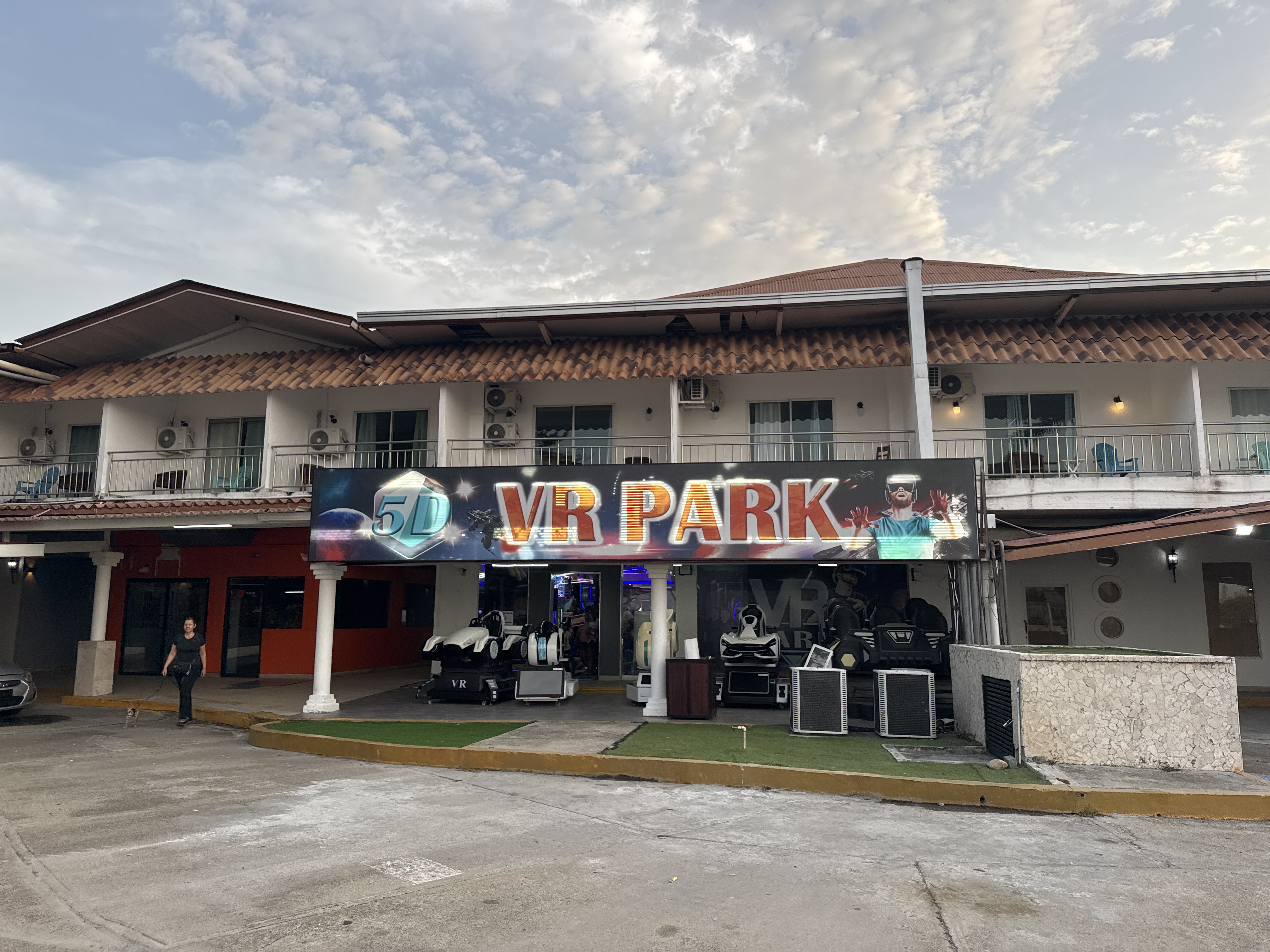
One of the more surreal juxtapositions in Panama City is finding a high-tech "5D" Virtual Reality park tucked into the ground floor of a Mediterranean-style building on the Amador Causeway. This area, known as Isla Perico, was once a restricted military zone used by the United States to defend the Pacific entrance of the Panama Canal. Today, it has been transformed into a leisure destination where the lines between physical history and digital escapism blur.
The term "5D" used on the signage is a common marketing flair in Latin America and Asia for immersive cinema. While "3D" refers to the visual depth, the extra "dimensions" typically refer to physical effects built into the seats and the environment. When users step inside, they encounter motion-simulation platforms that tilt and vibrate in sync with the VR headsets, often accompanied by environmental effects like blasts of air or water mists to simulate wind or rain.
What makes this specific spot interesting is its location on the Calzada de Amador. This six-kilometer road was built in 1913 using rock extracted during the excavation of the Culebra Cut for the Panama Canal. It connects the mainland to four islands: Naos, Culebra, Perico, and Flamenco. For nearly a century, these islands were part of a U.S. military base called Fort Grant, which was off-limits to Panamanian citizens. Following the Torrijos-Carter Treaties and the eventual handover of the Canal in 1999, the islands were repurposed for tourism.
The architecture above the VR park, with its tiled roofs and small balconies, reflects the residential and commercial boom that followed the handover. You’ll often find these types of entertainment centers operating right next to traditional seafood restaurants and ferry terminals, catering to local families and tourists who come to the Causeway for the ocean breeze and skyline views. It represents the "new" Panama—a place that transitioned rapidly from a strategic military outpost to a bustling hub of international commerce and modern entertainment.
5D VR Park at Isla Perico
Isla Perico is one of four islands connected to Panama City via the Amador Causeway, a 6-kilometer breakwater built using rock excavated during the construction of the Panama Canal. While originally a military outpost to defend the Pacific entrance of the canal, the area has transitioned into a tourism hub.
The "5D" branding used by establishments like this VR Park refers to entertainment technology that adds physical sensory effects—such as seat vibration, wind, water spray, or scent—to a standard 3D visual experience. These amusement centers are common in Latin American tourist zones, often utilizing hydraulic motion platforms and VR headsets to simulate roller coasters or combat scenarios.
This specific site sits within a commercial strip near the Isla Perico boat ramps, which serve as a primary departure point for ferries to the Pearl Islands (Archipiélago de las Perlas). The Pearl Islands are historically significant as the location where the 31.3-carat "La Peregrina" pearl was discovered in the 16th century, later owned by Mary I of England and Elizabeth Taylor.
The 5D VR Experience on Isla Perico
Brash neon aesthetics of a 5D VR Park on Isla Perico, a popular stop along Panama City’s Amador Causeway. The "5D" marketing refers to a sensory-heavy arcade experience combining 3D visuals with physical sensations like hydraulic motion seats, wind, water mists, and "leg ticklers" to simulate environment interaction.
These arcades often utilize commercial hardware from Chinese manufacturers like Zhuoyuan (FuninVR), featuring egg-shaped simulation pods and rotating 360-degree gravity chairs. While the tech is often a generation behind high-end consumer headsets, the appeal lies in the pneumatic platforms—active motion that tricks the inner ear into feeling G-forces or drops that home setups can't replicate.
Isla Perico itself is a man-made island transitioned from a former U.S. military site to a hub for duty-free shopping, marinas, and nightlife. The density of tourism here creates a market for these high-turnover, sensory-overload experiences.