UG
Ulrich Gall
Traditional Olive Press in Lima's Historic Olive Grove
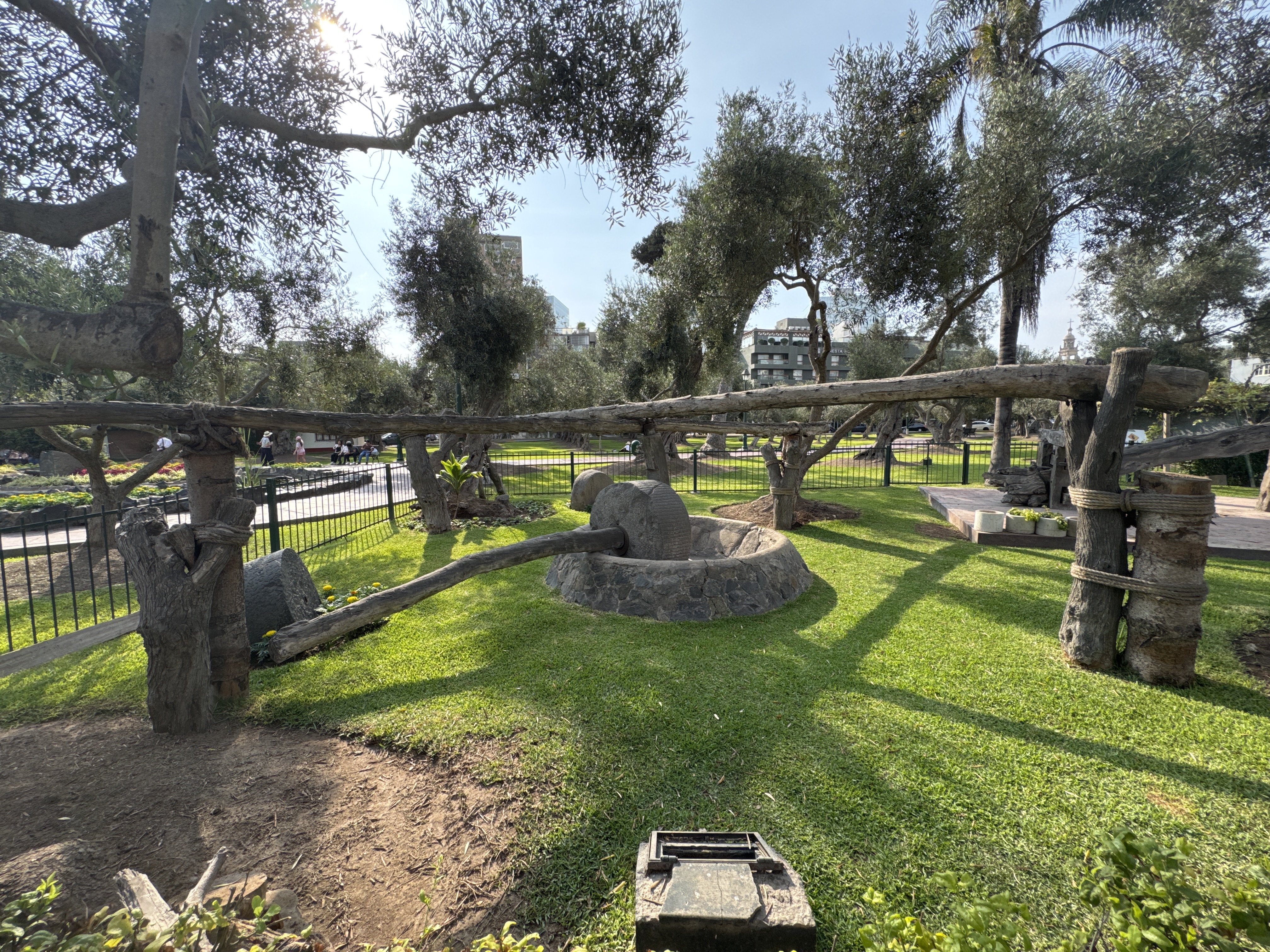
What you're looking at is a recreation of a traditional olive press, surrounded by actual olive trees, in a park that's dedicated to the very fruit it processes. This is likely part of the Parque El Olivar, or Olive Grove Park, an extraordinary green space in the San Isidro district of Lima, Peru.
Lima, a city often associated with a desert climate, might seem an unlikely place for an olive grove. However, the history of olives here dates back to the 16th century, when Antonio de Ribera, one of the first Spanish settlers, brought seedlings from Seville. He planted them on his estate, which eventually became this very park. These olive trees thrived in the unique microclimate of Lima, and for centuries, this grove was a major source of olive oil for the entire region.
The olive press equipment you see, with its large stone and wooden beams, illustrates the age-old method of extracting oil. Olives would be crushed under a heavy stone wheel, and the resulting paste would then be pressed to separate the oil. While modern techniques have replaced these traditional methods, this display serves as a wonderful reminder of the grove's historical significance and a connection to the artisanal past of olive oil production.
The park itself is not just a collection of trees; it's a preserved cultural and historical landmark, declared a National Monument in 1959. It's home to some of the oldest olive trees in the Americas, with many specimens dating back to the colonial era. Beyond its historical importance, the Parque El Olivar is also a vibrant ecosystem, attracting numerous species of birds, making it a popular spot for birdwatching and a tranquil escape from the bustling city. The combination of ancient trees, historical machinery, and a thriving natural habitat makes this park a truly unique urban oasis.
Traditional Olive Press in Lima's Historic Olive Grove
The device you see is a traditional olive press, likely a replica or restored example, in what is known as the "Bosque de Olivar" (Olive Grove) in San Isidro, Lima. This grove is one of the city's most emblematic parks, home to over 1,500 olive trees, many of which date back hundreds of years. The trees were originally planted by Antonio de Rivera in 1560, importing saplings from Seville, Spain. This specific type of press would have been used to extract olive oil, a vital commodity then and now, by crushing the olives between rotating stones. The design points to a simple, yet effective, mechanical process: large stones grind the fruit, and pressure is applied to separate the oil from the pulp and water. The Bosque de Olivar was declared a National Monument in 1959, not only for its ecological significance but also for its historical connection to Lima's colonial past and the early agricultural practices of the region.
Traditional Olive Press in El Olivar, Lima
This structure is a reconstruction of a traditional olive press (trapiche de aceite). It illustrates the historical method of extracting olive oil, crucial for early colonial Lima.
The grinding mechanism—a heavy, vertical stone roller (likely limestone or granite) would rotate in the circular stone basin, crushing the olives into a paste. The horizontal wooden beam connected the roller to a mule or ox for power.
The surrounding park space, *El Olivar*, San Isidro's most defining feature, is a remnant of a vast 16th-century olive grove, initially planted with 3-lobed olive cuttings smuggled from Spain. The oldest olive trees here are over 400 years old, descendants of those first plantings, making them some of the oldest living trees in Peru.