UG
Ulrich Gall
Ancient Olive Press in Lima's Historic El Olivar
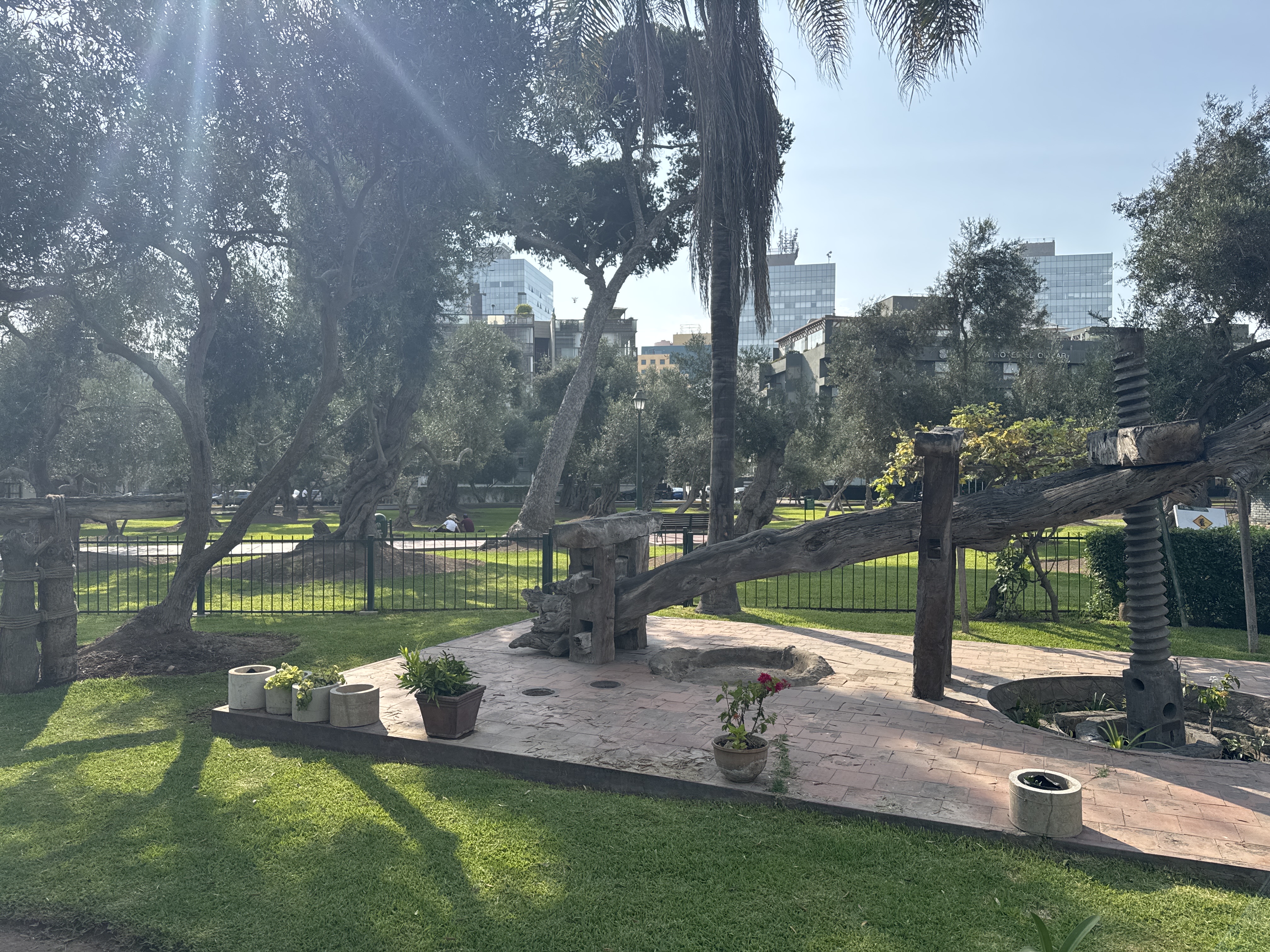
What you’ve discovered is an ancient olive press, an intriguing remnant of Lima's rich agricultural past, nestled within a grove of venerable olive trees. This isn't just an ornamental piece; it represents a significant part of the history of San Isidro, the district where you are. In fact, this entire area is known as El Olivar de San Isidro, or the Olive Grove of San Isidro.
The olive press itself, with its massive wooden beam and screw mechanism, was used to extract oil from olives. This process would have involved crushing the olives, likely with a large stone wheel, and then pressing the resulting paste to separate the oil from the pulp and water. The design you see is centuries old, reflecting a time when olive oil production was a cornerstone of the local economy and daily life. It’s a remarkable example of colonial-era technology.
The olive trees surrounding you are not just ordinary trees; they are direct descendants—and in some cases, the original trees themselves—from plantings that began in 1560. It's said that Antonio de Rivera brought hundreds of olive saplings from Seville, Spain, to Lima, and while many died during the journey, three survived. These three saplings formed the foundation of what would become this vast olive grove, which eventually supplied olive oil to much of the Viceroyalty of Peru. Imagine that; almost five centuries of continuous olive growth in this exact spot!
Over time, as Lima grew, much of the olive grove was developed, but thankfully, a significant portion was preserved as a public park. The surrounding buildings and urban landscape stand in stark contrast to the ancient trees and the press, highlighting the historical layers of this vibrant city. Looking closely at the olive trees, you might notice their gnarled trunks and sprawling branches, testaments to their age and resilience. They provide a serene, green oasis in the middle of a bustling metropolis, and are considered a national monument.
El Olivar Park's Ancient Olive Press
You've captured part of El Olivar Park in San Isidro, Lima, a unique urban olive grove steeped in history. The prominent wooden structure is a replica or an original piece of an olive press, representing the park's origins. These olive trees were planted in 1560 by Antonio Rodriguez, a Spanish conqueror, making them some of the oldest cultivated trees in South America. The park was originally part of a larger hacienda and provided olive oil for colonial Lima. Today, it's a protected national monument.
Historic Olive Press in El Olivar Park, Lima
This is a preserved **wooden olive press (trojall),** part of the historic **El Olivar Park** in San Isidro, Lima. The park, a national monument, is actually a vast 11-hectare olive grove, remnants of an 18th-century hacienda owned by the Count of San Isidro.
The press itself, with its large wooden beam and characteristic screw mechanism, was used to crush olives harvested from these trees to produce olive oil. The grove originally planted in the late 16th century by Antonio de Ribera, a Spanish noble. Most of the 1,700+ olive trees in the park today are centuries old. The olive trees thrive in Lima's mild coastal climate, a testament to early Spanish colonial agriculture adapting to the Pacific coast.