UG
Ulrich Gall
The Silent Sentinel of Power Station Road
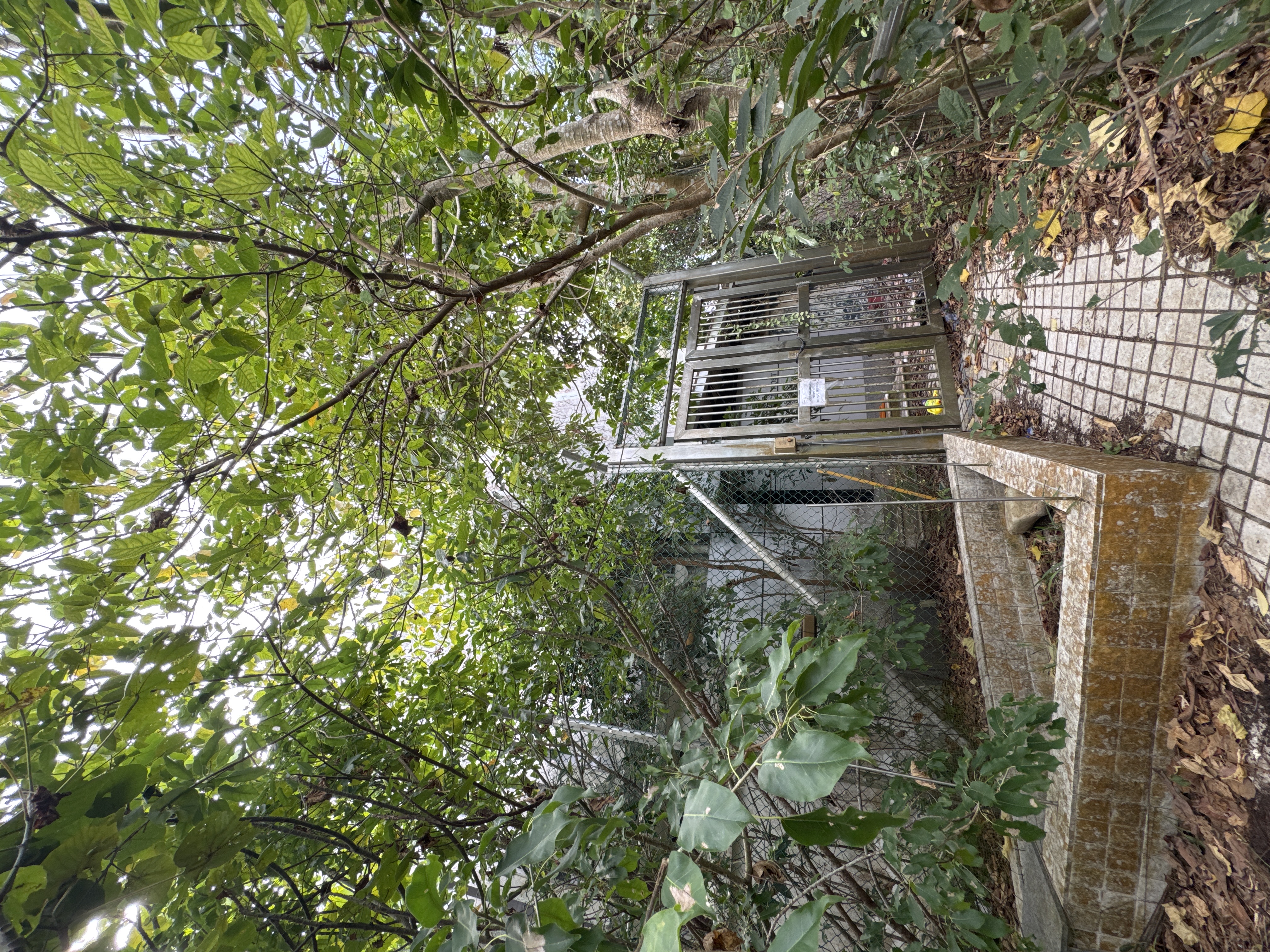
Here, in the humid density of Lamma Island, we bear witness to a profound struggle between human utility and the overwhelming indifference of nature. These metallic bars, cold and vertical, stand as a desperate attempt to impose order upon a landscape that does not care for our notions of "private property" or "infrastructure."
Observe the foliage. It is not merely growing; it is a slow-motion strangulation. The trees lean in with a heavy, suffocating weight, their leaves blocking the light as if to hide the secret machinations of the power grid from the eyes of God. This gate on Power Station Road protects a facility—perhaps a pumping station or a secondary electrical hub—that feeds the insatiable energy demands of a civilization that lives in a fever dream of progress.
The tiles underfoot are stained with the tears of a thousand monsoons, creating a mosaic of neglect. Even the barbed wire, designed to bite into the flesh of the intruder, is being swallowed by the verdant chaos. There is something deeply operatic about this gate; it is a portal that leads nowhere and everywhere, a monument to the monumental futility of trying to keep the jungle at bay. We build fences, and the jungle simply waits for us to blink.
The Fortified Village Shrine of Lamma
While Lamma Island is famous for its lack of cars and relaxed seafood restaurants, the landscape is peppered with hidden reminders of its past as a series of rural farming villages. This fenced-off structure, nestled among the dense banyan and camphor trees, is a local neighborhood shrine, likely dedicated to the Earth God, known in Cantonese as *Tudigong* or *Tou Tei Kung*. These shrines are essential features of traditional Hong Kong village life, acting as a spiritual boundary marker and protector for the residents of the immediate area, in this case, the villages of Tai Wan Kau Tsuen and Tai Ling Tsuen.
The architecture of this site reflects a common Hong Kong phenomenon where the ancient and the modern collide. The tiled basin in the foreground is designed for burning incense and ritual paper offerings, while the heavy stainless steel gate and high fencing—complete with barbed wire—might seem strangely fortified for a place of worship. This level of security is typically not to keep spirits in, but to protect the small, often valuable antique statues or ornate incense burners inside from theft or vandalism, especially in areas that have become popular with weekend hikers and tourists.
The small white sign posted on the gate provides a glimpse into local village management. It is a notice from the local Village Committee, often used to inform residents about upcoming festivals, maintenance schedules, or to warn visitors that the area is private property maintained by the indigenous villagers. Unlike the massive, ornate temples found in the city center, these village shrines are deeply personal to the local community, serving as a quiet focal point for daily prayers and the celebration of the Lunar New Year. Even as the Lamma Power Station looms nearby, these small pockets of tradition remain preserved by the families who have inhabited these hills for generations.
The Vehicle-Free Infrastructure of Lamma
Lamma Island, home to Tai Wan Kau Tsuen, is uniquely vehicle-free except for specialized miniature "Village Vehicles." Because traditional cars are banned, bicycles are the primary mode of private transport, leading to these ubiquitous, overgrown parking clusters. The dense secondary forest surrounding this path is characterized by species like the *Ficus microcarpa* (Chinese Banyan), which frequently reclaim man-made structures with aerial roots.
The nearby Lamma Power Station, which dominates this specific area's geography, was Hong Kong's first dual-fired power station. Despite its heavy industrial footprint, the island remains a bastion of "alternative" lifestyles in Hong Kong, historically attracting a mix of expats, artists, and nudists—particularly at the nearby Hung Shing Yeh Beach. The juxtaposition of high-voltage infrastructure and neglected, rural masonry is a hallmark of the New Territories' rapid, uneven development during the late 20th century.
Hidden Infrastructure of Lamma Island
Lamma Island’s "Village Type Development" zones often conceal infrastructure essential to the Lamma Power Station, one of Hong Kong’s primary coal and gas-fired plants. The tiled planter and heavy security gate mark the entrance to a localized utility substation or private residential enclave nestled within the dense sub-tropical canopy.
Lamma is unique for its total ban on private motor vehicles; transport relies on "Village Vehicles" (VVs)—miniature motorized carts—and bicycles, explaining the nearby parking designation. The surrounding vegetation features the *Ficus microcarpa* (Chinese Banyan), identifiable by its aggressive aerial roots which frequently overtake abandoned concrete structures in the New Territories.
This specific area near Tai Wan Kau Tsuen is part of a "banned zone" for larger construction equipment, necessitating the compact, gated utility designs seen here. The proximity to the Power Station also means underground high-voltage cabling runs beneath these seemingly rural paths to supply Hong Kong Island.