UG
Ulrich Gall
The Galactic Hermitage of Shuhe
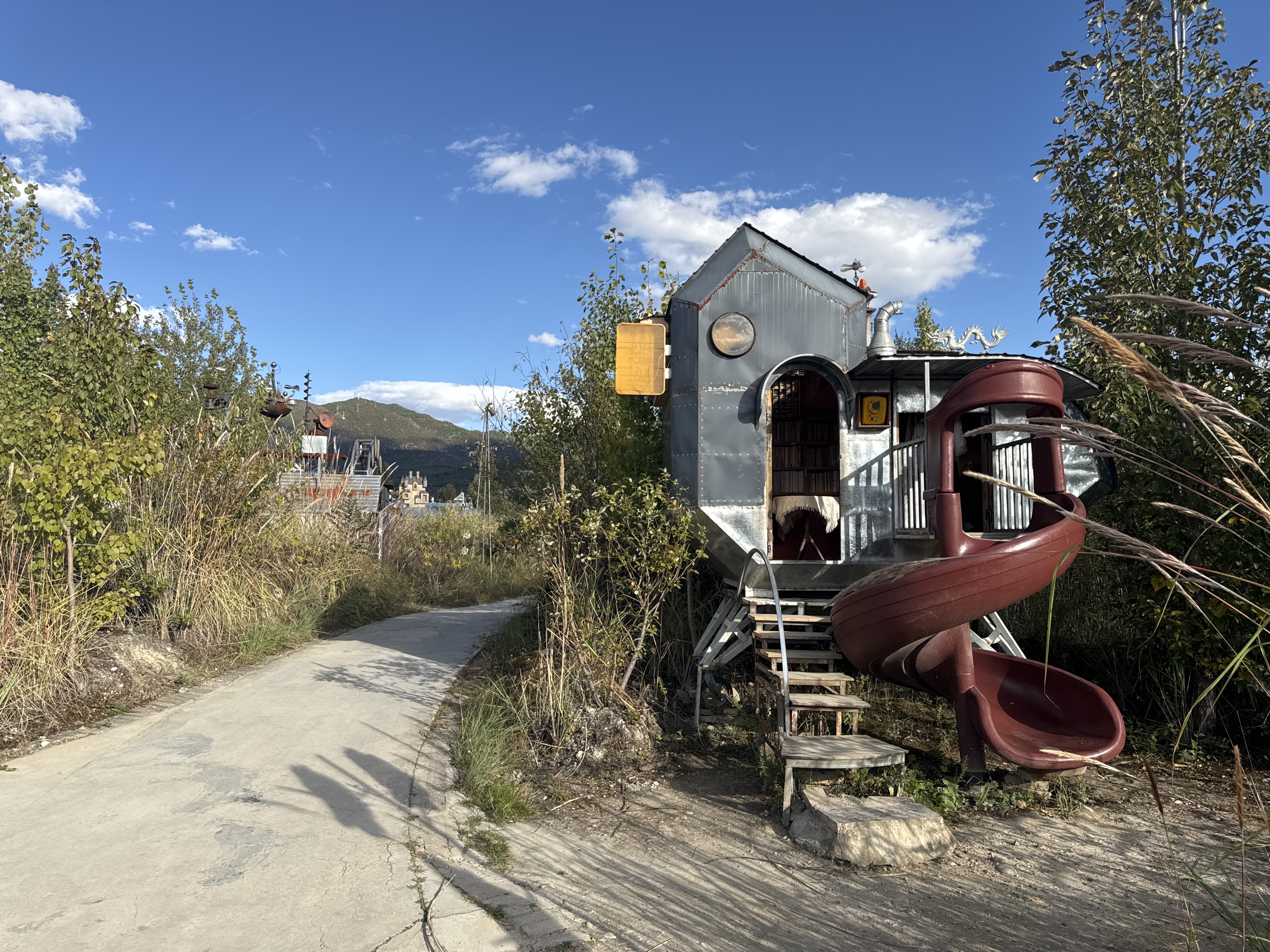
Here, in the indifferent landscape of Yunnan, we encounter a manifestation of the human delirium—a structure that occupies the precarious space between a lunar lander and a child’s fever dream. It is the Treehouse Cafe, though as you can plainly see, it possesses neither a tree nor a conventional sense of architectural dignity. It is a vessel of galvanized steel and rivets, standing on spindly legs as if it might, at any moment, decide to abandon its post and march toward the distant mountains in a futile search for meaning.
Observe the spiral slide, a crimson tongue of plastic that offers a swift descent into the crushing reality of the earth below. It is a metaphor for the gravity that governs our lives; one moment you are sipping a caffeinated beverage in a metallic pod, and the next, you are spat out onto the dirt, reminded of your own mortality. Inside, through the arched portal, one glimpses the order of books—thousands of pages of human thought, trapped within a hull that looks like it was scavenged from a discarded Soviet submarine.
The dragon perched atop the roof stares into the void of the blue sky, perhaps wondering why it has been fashioned from scrap metal to guard a place of leisure. This is not merely a cafe; it is an outpost of the absurd, a steampunk hermitage where one might contemplate the sheer chaotic beauty of a world that allows such a tiny, bizarre monument to exist amidst the tall grass and the silence of the Shuhe outskirts.
The Steampunk Retreat of Shuhe
This quirky structure is a prime example of the "steampunk" and DIY aesthetic that has carved out a unique cultural niche in the rural outskirts of Lijiang. While this region is famous for the ancient, tiled roofs of the Naxi people, this particular spot—known locally as the Treehouse Café (Shuwu Kafei)—represents a modern, bohemian counterculture. It serves as a retreat for artists and "digital nomads" who have moved to Yunnan province to escape the high-pressure life of China’s tier-one cities like Beijing or Shanghai, a movement often called "tang ping" or "lying flat."
The structure itself is a whimsical blend of industrial materials and playful imagination. It is elevated on metal stilts, mimicking a lunar lander or a futuristic outpost, yet it is topped with a traditional Chinese dragon ornament, blending sci-fi vibes with local mythology. The burgundy spiral slide serves as a playful alternative to the stairs, reinforcing the idea that this is a space for "adult play" and creative decompression.
Inside the small circular doorway, you can see shelves packed with books. In this part of China, such spaces often function as "book bars" or communal libraries where travelers are encouraged to slow down. The weathered corrugated metal and exposed rivets are intentional design choices meant to evoke a sense of "wabi-sabi"—finding beauty in imperfection and the passage of time—which contrasts sharply with the hyper-modern, glass-and-steel architecture found in most of urban China. The surrounding landscape of Shuhe is known for its clear air and views of the Jade Dragon Snow Mountain, making it a magnet for those seeking a more eccentric, slow-paced lifestyle.
Steampunk Treehouses of Shuhe
The Treehouse Cafe (树屋咖啡馆) in the Shuhe area of Lijiang is part of a growing trend in rural China known as "Wild Luxury" (野奢) or "Instagrammable Architecture." Unlike the traditional Naxi architecture of the nearby Shuhe Ancient Town, these structures utilize industrial materials—galvanized steel, repurposed plastic slides, and porthole windows—to create a steampunk-inspired aesthetic designed specifically for social media engagement on platforms like Xiaohongshu.
This specific site functions as a multi-purpose creative space, often serving as a book bar, art studio, or private rental for content creators. The use of elevated "stilt" foundations is a modern, playful riff on the traditional Ganlan-style (dry-column) architecture common in Southwest China, which was originally designed to protect inhabitants from moisture and snakes. In contemporary Yunnan, these eccentric builds are frequently part of "Cultural and Creative Parks" (文创园), which revitalize rural land by attracting urban domestic tourists seeking a "Bohemian" escape from China's Tier-1 cities.
Steampunk Pods of Aranya Lijiang
Experimental steampunk architecture in Lijiang’s Aranya residential district. Part of the "Tree House Cafe" (树屋咖啡馆) complex, these structures blend recycled industrial aesthetic—corrugated metal, rivets, and lunar-lander struts—with whimsical play elements like the integrated spiral slide.
Aranya Lijiang is a lifestyle-focused development designed by high-profile architects to contrast with the nearby UNESCO-listed Shuhe Ancient Town. While Shuhe emphasizes traditional Naxi timber frames and stone canals, this site prioritizes "architectural loneliness" and avant-garde escapism for China's urban elite. Inside these pods, spaces are often used as private tea rooms or mini-libraries. The dragon ornament on the roof and the nearby wind turbines reflect a mix of local folklore symbols and the high-altitude, windy climate of the Yunnan plateau. Often used as "social media bait" (Wanghong) to drive tourism to real estate developments.