UG
Ulrich Gall
The Vegetable Ivory of Lijiang
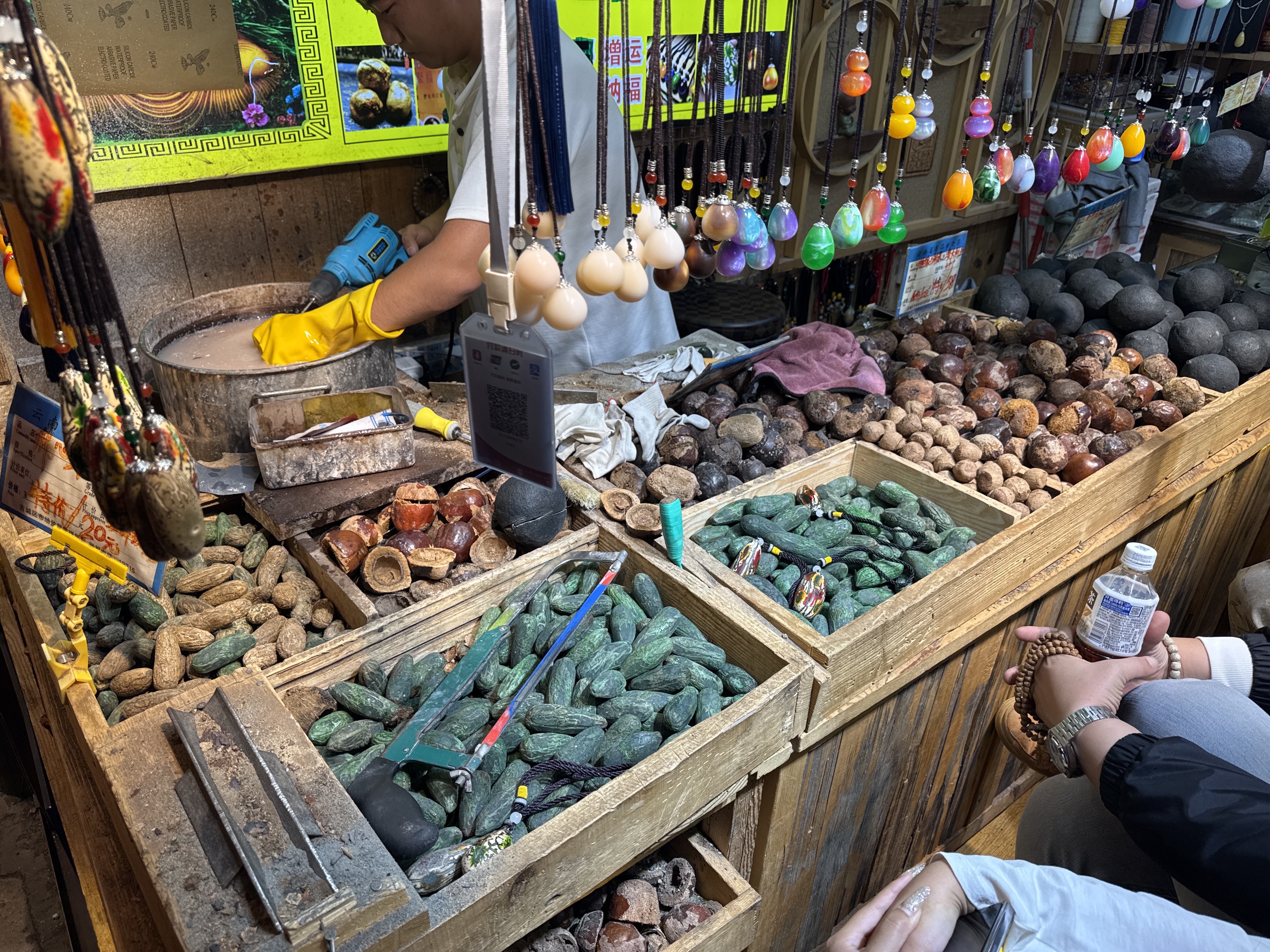
Hidden within these seemingly ordinary, nut-like shells is a tradition of high-altitude craftsmanship unique to the Himalayan foothills. These are Tagua nuts, often referred to as "vegetable ivory." They are the seeds of certain palm trees found in tropical regions, but they have become a staple of artisan stalls in Lijiang because their extreme density and creamy white interior make them a sustainable and ethical alternative to animal ivory.
The various stages of production are laid out here: from the rough, brown, brain-like outer husks to the smooth, teal-dyed cores. The green hue is a popular local aesthetic choice, achieved by soaking the porous nut in dye before it is polished. You can see the artisan using a handheld power drill to hollow out the centers or carve intricate patterns into the seeds. This process transforms a rock-hard seed into the delicate, colorful pendants hanging above the counter. Some of these are shaped like gourds, or *hulu*, which in Chinese culture are powerful symbols of health, longevity, and the warding off of evil spirits.
The yellow sign in the background mentions "增运纳福" (*zēng yùn nà fú*), which translates to "increasing your luck and receiving blessings." These charms are not just decorative; they are intended as talismans for travelers and locals alike. The dark, charcoal-colored spheres at the back are often another variation of these nuts or perhaps medicinal seed pods, sometimes used as hand-massage balls to improve circulation. In a city like Lijiang, which was a major stop on the Ancient Tea Horse Road, this blend of natural materials and spiritual symbolism continues a long history of trading exotic goods across the mountains of Yunnan.
Vegetable Ivory Carving
These small, egg-shaped pendants are carved from the fruit of the *Hyphaene thebaica* palm, commonly known as the Doum palm or "vegetable ivory." While the palm is native to the Nile Valley, its dried, rock-hard seeds are a staple in Yunnan’s artisanal markets. The outer rind is often shaved away to reveal a creamy white interior that mimics animal ivory in texture and durability, which explains the use of power tools for carving and polishing.
The colorful, swirling patterns on the finished pieces are achieved through a process of immersion dyeing or resin coating. Historically, Doum palm nuts were a significant source for button manufacturing in Europe and North America before the advent of plastics. In local Naxi culture, these are frequently sold as "bodhi seeds," a broad term for various plant seeds used in Buddhist prayer beads, though the Doum palm is not botanically related to the sacred Bodhi tree (*Ficus religiosa*).
The Vegetable Ivory of Lijiang
Bodhi seeds (strictly *Hyphaene thebaica* or Doum palm nuts) and Tagua nuts, often called "vegetable ivory." Central to Tibetan Buddhist culture in Yunnan. Used for *mala* prayer beads.
The green, oblong items are unpolished **"Jade Bodhi"** seeds. Despite the name, they aren't from a Bodhi tree (*Ficus religiosa*) but are the inner endosperm of palm fruits. Once the rough outer skin is sanded down (the process seen with the power drill), they reveal a smooth, ivory-like white or pale green interior.
The large, dark spherical objects are **"Black Gold" Bodhi** or coconut shells carbonized and compressed. The brown, textured nuts are **Rudraksha** (*Elaeocarpus ganitrus*), valued for the number of "faces" (*mukhi*) or natural clefts; more faces equal higher spiritual value and price.
Note the drill and water bucket: the vendor is "opening" the seeds to show the quality of the "ivory" inside. While marketed as local Naxi or Tibetan craft, these seeds are globally sourced (mostly Southeast Asia and Africa) and processed in Lijiang for the tourist market.